The risk of a historic El Niño in 2026–27 has strengthened again. NOAA now sees a greater than 90% chance of a very strong event during the Northern Hemisphere autumn and winter, while the probability of an historically extreme peak has increased further.
For the cashew market, this reinforces the climate risk highlighted in our July update. But the distinction remains important: the evidence for an exceptional El Niño has become considerably stronger, while verified evidence of damage to the 2027 cashew crop is still limited.
The historic El Niño scenario has become more credible
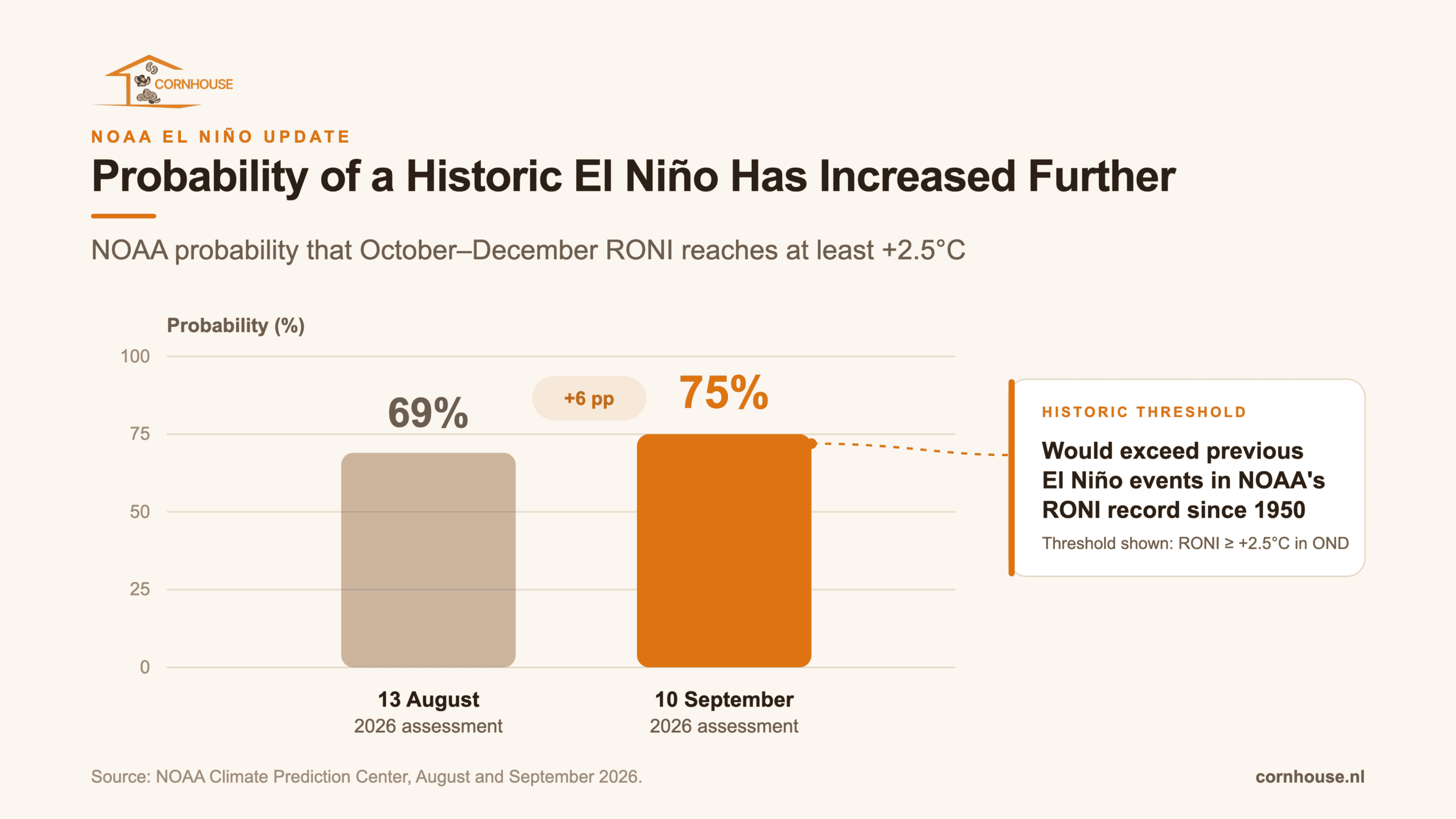
When we last assessed the outlook in late July, NOAA assigned an 81% probability to a very strong El Niño during October–December 2026.
The latest NOAA Climate Prediction Center update, issued on 10 September, now puts the probability of a very strong event above 90%. More notably, NOAA gives a 75% chance that the three-month Relative Oceanic Niño Index (RONI) will reach at least +2.5°C during October–December. At that level, the event would exceed the strength of previous El Niño episodes in NOAA’s record dating back to 1950.
Observed conditions have also continued to strengthen. The Niño 3.4 index reached +1.8°C in August, up from +1.4°C in July, while sea-surface temperature anomalies exceeded +3.0°C in parts of the eastern equatorial Pacific. NOAA also reported widespread subsurface temperature anomalies above +10°C at depth.
Oceanic and atmospheric indicators therefore continue to move in the same direction: El Niño is strengthening and is expected to intensify further towards the end of 2026.
The World Meteorological Organization has reached a similarly strong conclusion. Its 3 September update described El Niño as firmly established and expected it to reach very strong intensity before peaking towards the end of the year. WMO forecasts indicate a nearly 100% probability that El Niño will persist through February 2027.
The question has therefore shifted. Whether a strong El Niño will occur is becoming less uncertain. What matters increasingly for cashews is how the event translates into weather across the main producing regions.
Weather risks are becoming more relevant for Southeast Asia
Vietnam’s latest seasonal forecast provides one of the clearest origin-specific warning signals as the historic El Niño continues to strengthen.
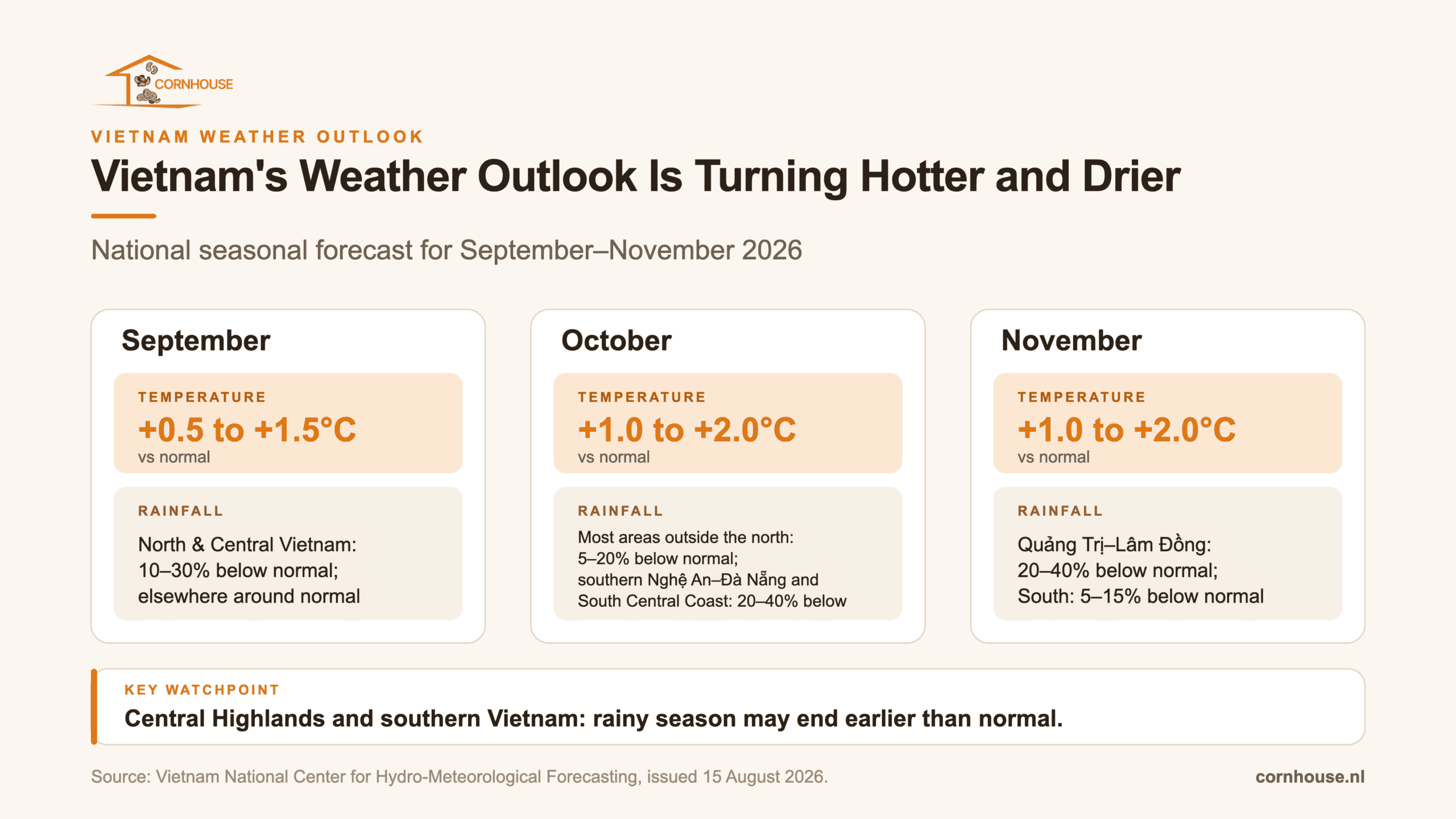
The country’s National Center for Hydro-Meteorological Forecasting expects a 93% probability of very strong El Niño conditions during September–November, rising to 95% for October–December. Average temperatures are forecast to be around 0.5–1.5°C above normal in September and generally 1–2°C above normal during October and November.
Rainfall is more important to the crop outlook than the El Niño classification by itself, and here the forecast becomes more mixed geographically.
Vietnam expects rainfall during October to be 5–20% below normal across many areas outside the north, with deficits of 20–40% forecast from southern Nghệ An to Đà Nẵng and along the South Central Coast. During November, rainfall from Quảng Trị to Lâm Đồng is also forecast at 20–40% below normal.
That does not translate directly into a national cashew crop loss. Cashew production is concentrated in particular growing areas, and local rainfall, soil moisture, tree condition and the timing of flowering will matter more than broad national averages.
The wider ASEAN outlook reinforces the need for caution. The ASEAN Specialised Meteorological Centre expects strong El Niño conditions during September–November, above-normal temperatures across most of the region and an increased probability of below-normal rainfall. However, the strongest dry signal is concentrated over much of the Maritime Continent rather than uniformly across Mainland Southeast Asia.
In other words, the regional climate signal has strengthened, but it still cannot be applied mechanically to Vietnam or Cambodia’s cashew-producing areas.
Crop evidence still lags behind the climate warning
This is the most important point for the cashew market.
There is still insufficient evidence to conclude that Vietnam or Cambodia will produce a materially smaller 2027 crop because of the historic El Niño. Nor does a stronger Pacific anomaly by itself establish losses in India, Africa or Brazil.
India also remains worth watching. The India Meteorological Department reported in early September that subdued rainfall activity was likely to continue over Peninsular India during the following week. This follows the substantial South Peninsular rainfall deficits already highlighted in our July analysis.
But rainfall deficits are risk indicators, not production estimates.
As the Asian crop cycle progresses, field evidence will become increasingly important. The market should now watch whether heat and rainfall anomalies begin to affect vegetative development, water availability, tree condition and eventually flowering and fruit setting.
That evidence will determine whether the increasingly exceptional climate event becomes an actual cashew supply story.
The risk has strengthened. The crop verdict has not.
Since July, the probability of a historic El Niño has increased materially. NOAA now assigns a 75% probability to an October–December event strong enough to exceed previous El Niño episodes in its historical record, while WMO expects the event to persist well into early 2027.
That makes weather risk harder for the cashew market to ignore.
It still does not justify declaring a 2027 crop problem.
Over the coming months, the most useful signals will increasingly come from the producing regions themselves: rainfall and soil moisture in key growing areas, tree condition, flowering development and early crop assessments in Vietnam, Cambodia and India.
For now, the conclusion remains measured: the climate warning has become significantly stronger, but the cashew crop evidence has not yet caught up.

 We use cookies to ensure you get the best experience on our website. For more information, please read our