A strengthening 2026–27 El Niño is arriving at a sensitive point for the global peanut market. In this El Niño peanut market story, Argentina and Brazil are moving towards planting and early crop development as the climate event approaches its expected peak, while the United States is beginning to harvest a crop currently forecast to be 27% smaller than last year.
The U.S. supply picture is not straightforward, however. Although the new crop is sharply smaller, commercial peanut stocks remain substantially higher than a year ago. That buffer reduces the immediate risk of a supply shortage, while making South American crop development an increasingly important variable for the months ahead.
For now, there is still no evidence that El Niño is damaging peanut production in Argentina or Brazil. Additional rainfall could initially support planting and establishment. The risk would rise if rainfall becomes excessive, poorly distributed or persists into sensitive reproductive and harvest periods.
El Niño timing matters more than the headline
NOAA’s 10 September outlook showed El Niño continuing to strengthen, with a greater than 90% chance of a very strong event during Northern Hemisphere autumn and winter 2026–27. Niño-3.4 reached +1.8°C in August, while temperatures were even further above normal in the eastern equatorial Pacific.
Cornhouse recently examined the same developing climate event from a different commodity perspective, looking at what a potentially historic El Niño could mean for the 2027 cashew crop.
For peanuts, however, the strength of El Niño alone says relatively little about the eventual crop outcome.
The timing is more important.
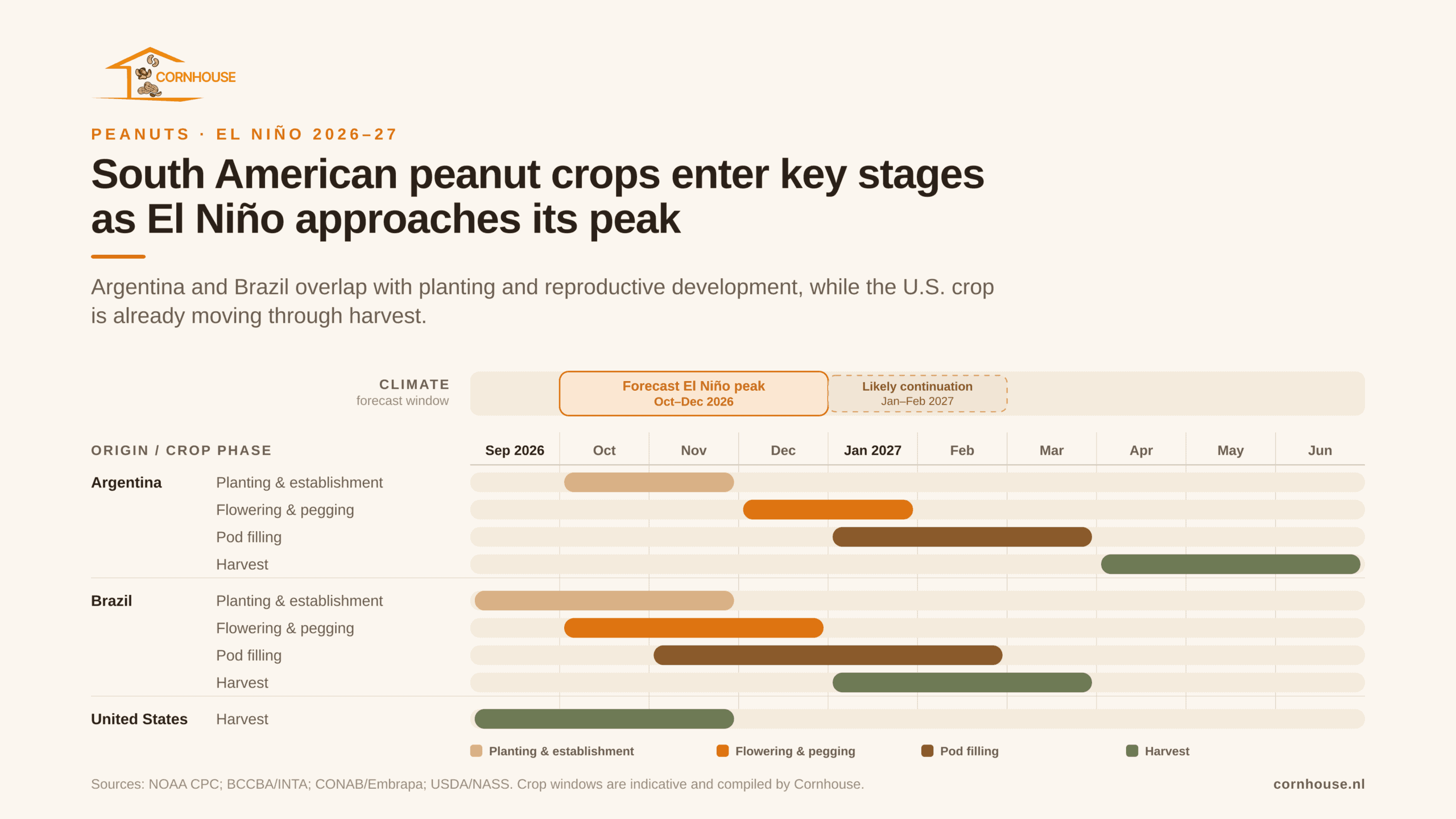
In Argentina and Brazil, the expected late-2026 peak overlaps directly with planting, establishment and reproductive development. In the United States, most yield formation has already taken place and harvesting is now underway.
The three origins therefore face very different exposure to the same climate event.
Adequate rainfall can support peanut establishment and pod development, particularly in rain-fed production systems. Persistent excess moisture can have the opposite effect, increasing disease pressure, restricting field access and eventually complicating digging, curing and harvest.
This makes the relationship between El Niño and peanut production inherently non-linear: more rainfall is not automatically negative, and a very strong El Niño does not automatically imply crop losses.
U.S. production is sharply lower, but stocks provide a large buffer
The United States provides the clearest immediate supply-side change.
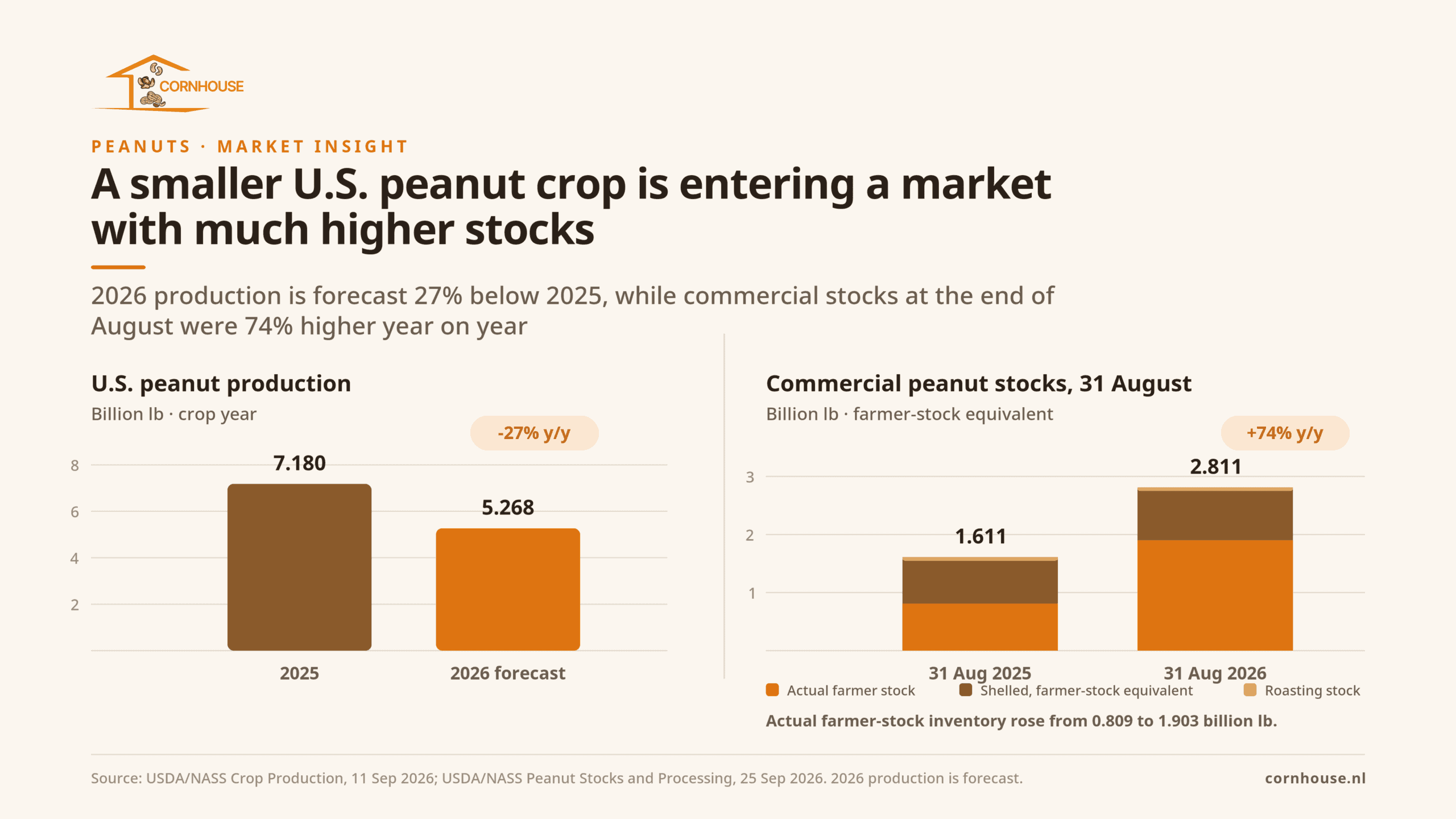
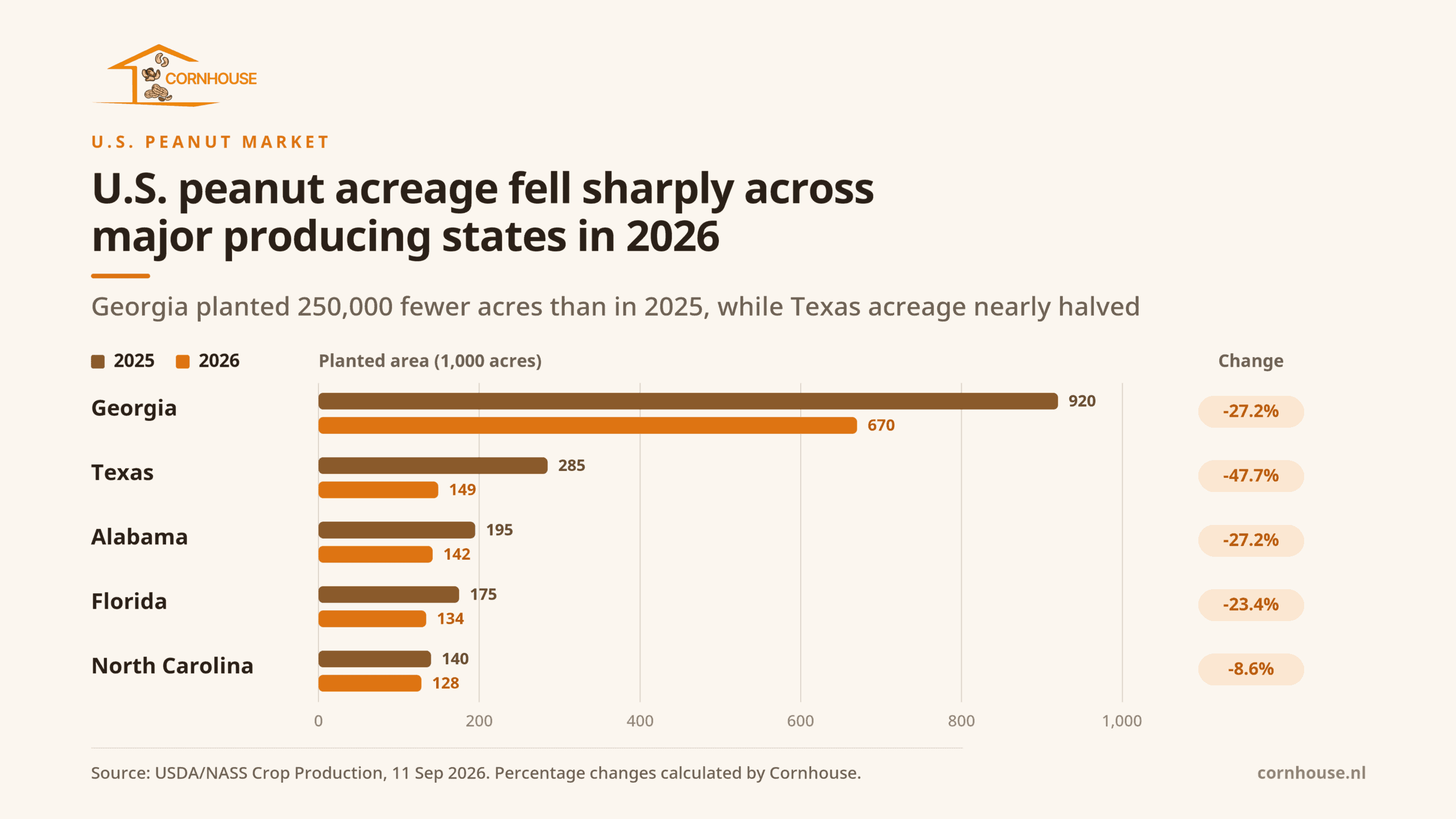
USDA’s September estimate puts 2026 peanut production at 5.27 billion pounds, down 27% from 2025. Planted area is estimated at 1.41 million acres, 28% below last year, while harvested area is forecast 29% lower.
The reduction is overwhelmingly an acreage story rather than an El Niño story. Weak grower economics following the large 2025 crop and abundant supply encouraged a substantial reduction in planted area.
The latest harvest data reinforce the distinction. By 27 September, 12% of the U.S. peanut crop had been harvested, up from 5% one week earlier. That remained slightly behind 16% at the same point last year and close to the five-year average of 13%. Georgia, the largest producing state, was 11% harvested; Florida 20%; Alabama 10%; and Texas 14%.
Crop condition also remains relatively stable. USDA rated 58% of the crop good or excellent as of 27 September, down from 60% a week earlier but above 55% at the same stage last year. Georgia stood at 56% good/excellent, Florida at 69% and North Carolina at 86%, while Texas was lower at 45%.
There is therefore no evidence in the latest USDA data of a sudden national crop deterioration.
More importantly, the smaller 2026 crop is entering a market with a substantial inventory cushion.
USDA reported 2.81 billion pounds of equivalent farmer-stock peanuts in commercial storage on 31 August, compared with 1.61 billion pounds a year earlier. Actual farmer-stock peanuts accounted for 1.90 billion pounds of the total, versus 809 million pounds a year ago.
That changes the interpretation of the smaller crop.
U.S. production is materially lower, but current stocks mean this does not translate directly into a tight market. Instead, the smaller crop reduces the additional cushion available if production or quality problems later develop elsewhere.
Argentina enters planting with supportive moisture
Argentina’s principal peanut-producing region, Córdoba, is approaching the 2026/27 planting season from a comparatively favourable moisture position.
Rainfall during July and August ran above historical averages across the province and helped recharge soil profiles ahead of summer planting. Rainfall between 9 and 11 September provided further useful surface moisture, which the Bolsa de Cereales de Córdoba described as beneficial for the beginning of the summer campaign.
Further rainfall was recorded across Córdoba between 18 and 21 September, confirming that the wetter start to spring has continued. BCCBA has not, however, reported peanut crop damage from these events.
Current seasonal forecasts continue to favour above-normal rainfall across much of Córdoba during September–November. At this stage, that does not necessarily represent a negative development.
Well-distributed moisture during planting and establishment can support emergence and reduce early-season drought risk. The concern would increase if above-normal rainfall develops into persistent saturation once the crop moves into flowering, pegging and pod development later in the year.
There is also an acreage factor to monitor. BCCBA’s initial 2026/27 survey indicated lower peanut area in Córdoba compared with the previous season, although a definitive national Argentine production forecast was not yet available in the research used for this article.
That means Argentina may begin the season with a somewhat smaller acreage buffer before weather becomes a production factor.
Importantly, the main Argentine harvest occurs considerably later, generally from around April into June. It remains premature to assume that the forecast late-2026 El Niño peak will translate directly into a problematic Argentine harvest.
Brazil has the most direct crop-stage overlap
Brazil may have the strongest direct overlap between the expected El Niño peak and the peanut production cycle.
São Paulo remains the country’s dominant peanut-producing state. Planting takes place around the start of the rainy season, with establishment, flowering, pegging and early pod development occurring through the period in which El Niño is expected to remain strong.
Brazil’s weather signal remains more complicated than a simple “El Niño equals wet São Paulo” relationship.
Official seasonal forecasts have shown wetter probabilities across parts of São Paulo and neighbouring areas, but not uniformly across the entire peanut-producing region. Above-normal temperatures also remain a factor across large parts of Brazil.
September has already been wet in parts of São Paulo. INMET reported that several weather stations had reached record September rainfall totals within the first 14 days of the month. Those observations demonstrate that substantial rainfall is occurring in parts of the state, but they do not establish peanut damage and should not be extrapolated across the entire production belt.
The downside risk would become more meaningful if wet conditions persist through reproductive development or continue into the January–March harvesting period, when excess rainfall could complicate disease management, digging and curing.
CONAB has now published its final 12th survey for the 2025/26 grain season, and its peanut historical datasets were updated on 15 September. However, its separate Perspectivas para a Agropecuária 2026/2027 publication does not provide a regular 2026/27 peanut crop estimate.
The first regular CONAB grain survey for 2026/27 is scheduled for 15 October, and peanuts are included in CONAB’s grain-monitoring universe.
For now, Brazil therefore remains primarily a planting and weather-risk story, rather than an officially forecast production-loss story.
Why South America still matters in the El Niño peanut market
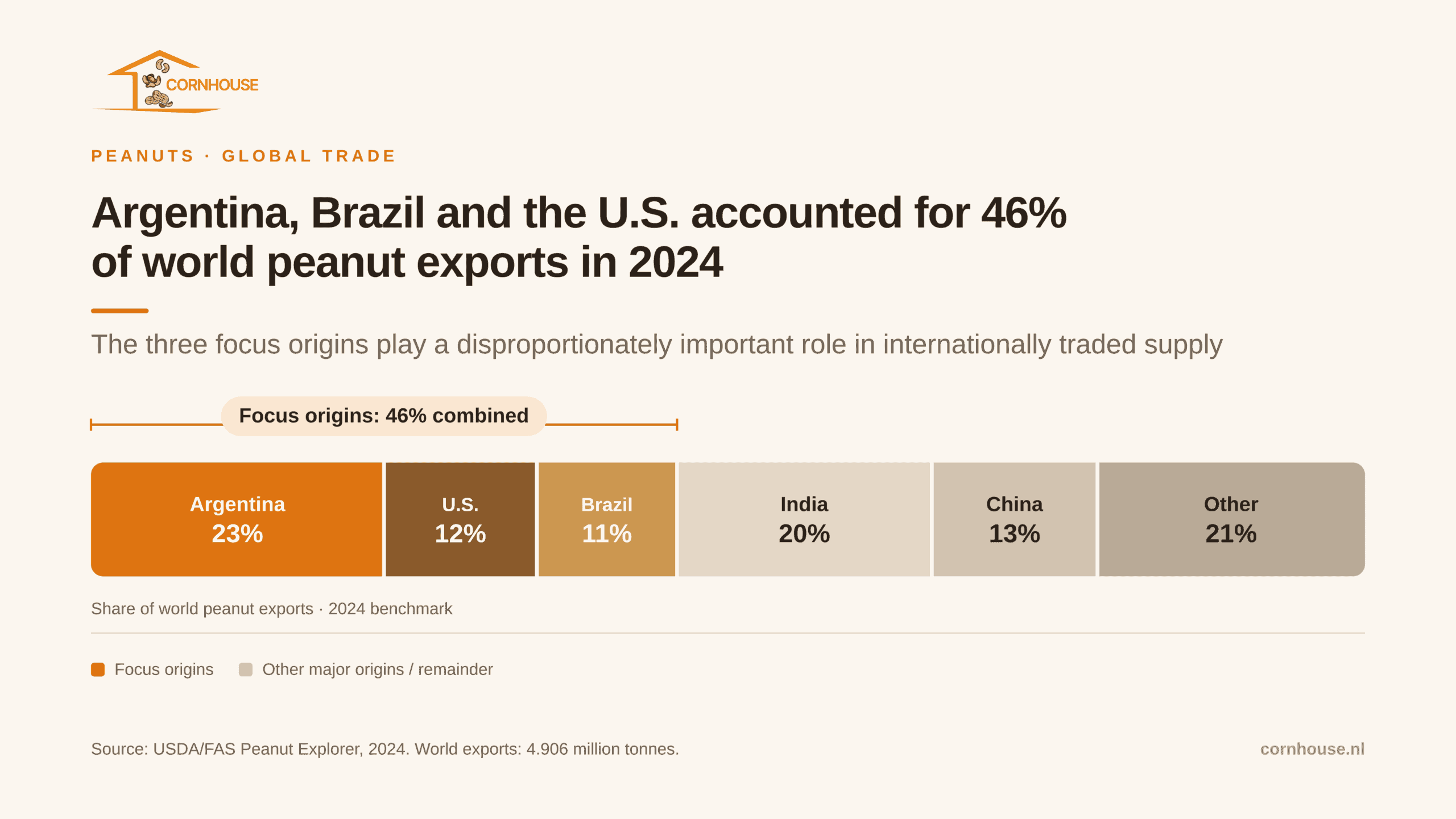
Argentina, Brazil and the United States hold an important position in internationally traded peanuts.
Using USDA/FAS’s 2024 structural export benchmark, Argentina accounted for approximately 23% of world peanut exports, the United States 12% and Brazil 11%. Together, the three represented roughly 46% of global exports in that dataset.
That does not mean the global peanut market is becoming short.
India and China remain major participants, while the latest U.S. stocks data show that the exceptionally large 2025 crop left a substantial supply buffer.
That buffer is now one of the most important qualifications to the El Niño story.
A normal South American crop combined with current U.S. inventories could leave overall availability relatively comfortable despite lower 2026 U.S. production.
A simultaneous production or quality problem in Argentina and Brazil would be different. It would make the smaller U.S. crop more commercially significant and could reduce the inventory cushion available to international buyers.
The risk is therefore conditional rather than immediate.
What the peanut market should watch next
Over the coming weeks, regional crop indicators will become more informative than further changes in the headline El Niño index.
For Argentina, attention should move towards planting progress, rainfall distribution and soil moisture across Córdoba. Later, conditions during flowering, pegging and pod filling will determine whether the current moisture advantage remains supportive or becomes excessive.
For Brazil, São Paulo rainfall distribution and planting conditions will be critical. CONAB’s first 2026/27 grain survey on 15 October should provide the first official baseline against which subsequent crop developments can be measured.
In the United States, harvest progress, USDA production revisions and the pace at which the current inventory buffer is drawn down will matter more than El Niño itself for the 2026 crop.
El Niño remains a risk multiplier, not a crop-loss signal
The evidence has become clearer since mid-September, but the central conclusion has not changed.
A potentially exceptional 2026–27 El Niño is developing at a commercially sensitive moment for peanuts. That distinction between a strengthening climate signal and confirmed crop impact also underpinned our earlier analysis of the developing 2026–27 El Niño risk. Argentina and Brazil are entering weather-sensitive stages while U.S. production is forecast sharply below last year’s unusually large crop.
At the same time, high U.S. inventories provide an important buffer, and there is still no verified evidence that El Niño has reduced South American peanut production.
For now, rainfall may still be more supportive than damaging.
The market story would become materially stronger only if conditions in Córdoba or São Paulo begin to show persistent excess moisture, planting disruption, disease pressure or later quality and harvest problems.
The key question is therefore not simply how strong El Niño becomes, but whether the climate signal translates into adverse crop conditions, and whether those problems are large enough to overcome the supply cushion currently visible in the United States.

 We use cookies to ensure you get the best experience on our website. For more information, please read our