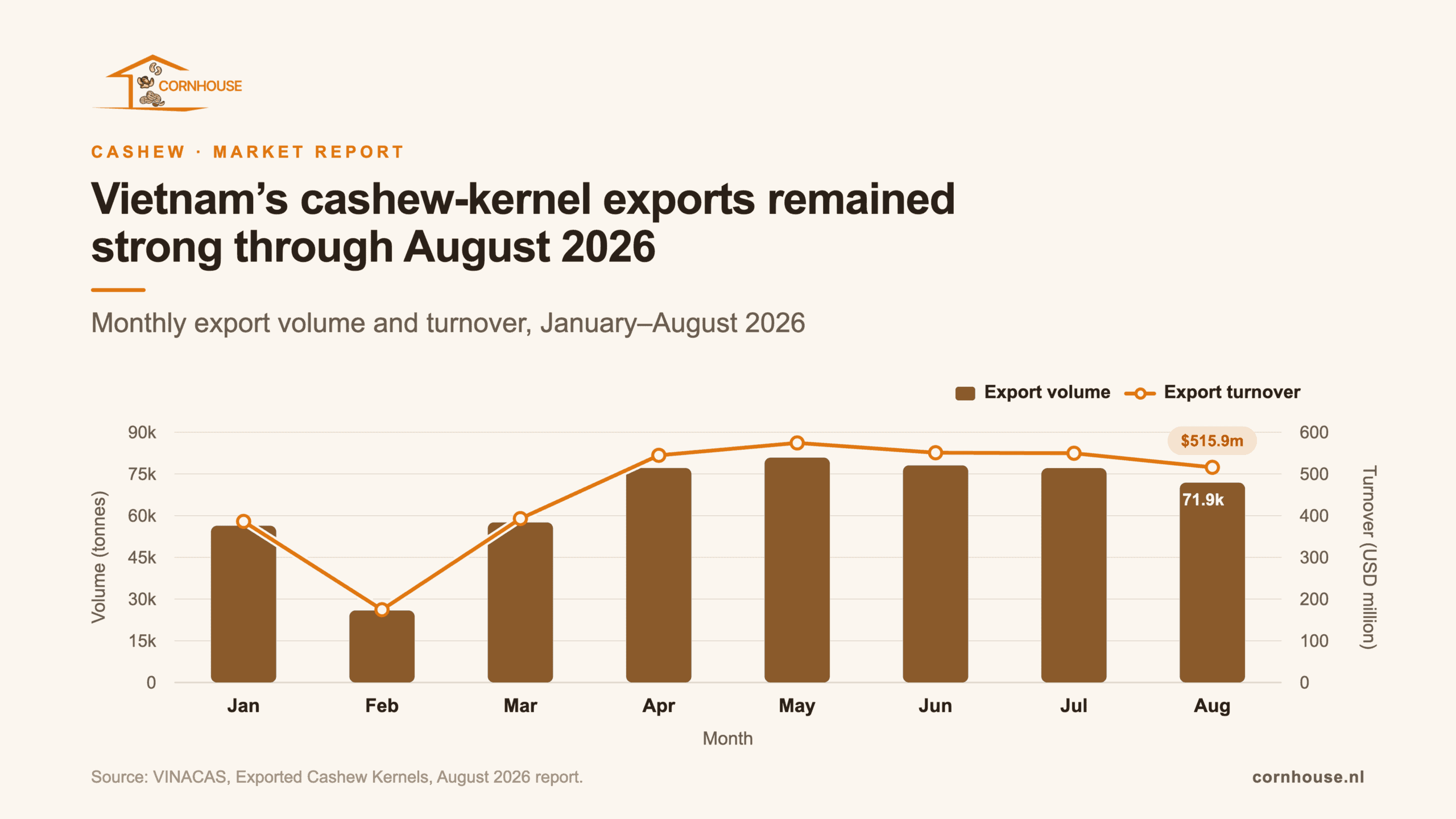
Vietnam’s cashew market remained active in August 2026, with the country exporting 71,864 tonnes of cashew kernels while raw cashew nut imports increased to 335,082 tonnes. For the first eight months of the year, total kernel exports reached 524,916 tonnes, up 5.40% year on year, with export turnover rising 8.89% to USD 3.69 billion.
At the same time, Vietnam’s raw cashew nut (RCN) imports strengthened again in August. Imports reached 335,082 tonnes, 17.54% higher than in August 2025, while the average import value increased 7.29% year on year. The latest figures come as VietPhi reports a firmer raw-material market, with good-quality West African RCN becoming less readily available as the season moves towards its end. This continues the pattern seen in our July Vietnam cashew market update, when strong exports coincided with increasing attention to RCN quality and processor margins.
August export volume eases while export value remains higher
Vietnam’s cashew-kernel exports reached 71,864 tonnes in August, down 1.05% compared with August 2025. Export turnover nevertheless increased 4.93% to USD 515.9 million, reflecting a higher average export value.
VINACAS reported an average export value of USD 7,179 per tonne in August, 6.05% above the same month last year. Compared with July, export volume declined from 77,093 tonnes, while the average export value increased slightly from USD 7,130 per tonne.
Across January to August, Vietnam exported 524,916 tonnes, compared with approximately 498,000 tonnes during the same period of 2025. The value of these exports reached USD 3.69 billion, up 8.89% year on year, while the average export value for the period stood at USD 6,992 per tonne.
China remains Vietnam’s largest individual export market
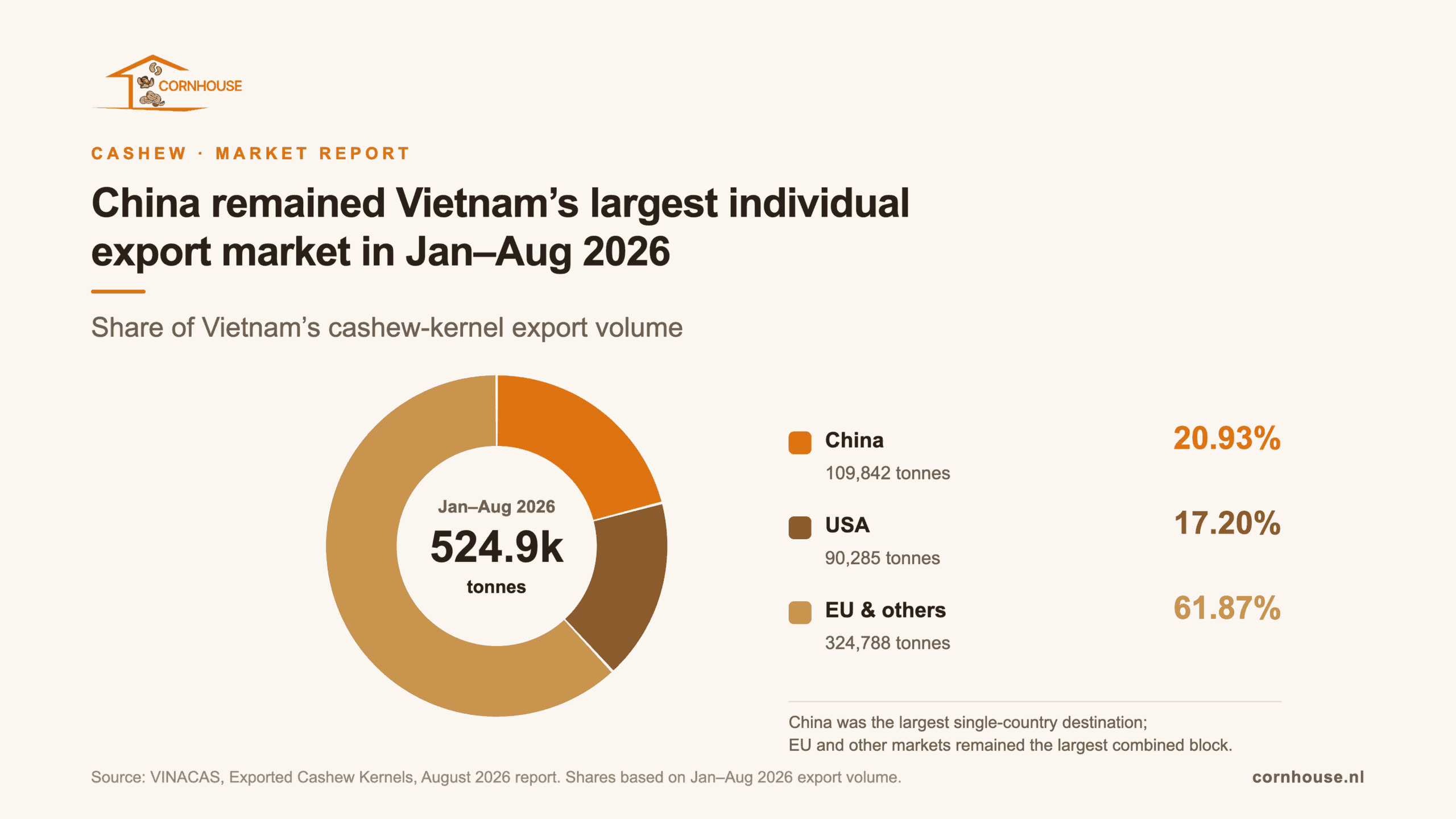
China remained Vietnam’s largest individual destination during August, receiving 14,833 tonnes of cashew kernels. This was 27.27% higher than in August 2025 and represented 20.64% of Vietnam’s total export volume during the month.
The United States followed with 11,668 tonnes, up 6.41% year on year and accounting for 16.24% of August exports. Singapore ranked third at 6,621 tonnes, followed by the United Arab Emirates and Turkey.
For the first eight months of 2026, Vietnam shipped 109,842 tonnes to China, an increase of 14.37% year on year. China accounted for 20.93% of total export volume. China had already moved ahead of the United States as Vietnam’s largest individual export destination during the first half of 2026, a shift covered in our H1 Vietnam cashew export update.
Exports to the United States reached 90,285 tonnes, up 25.56%, giving the market a 17.20% share. The EU and other destinations together accounted for the remaining 61.87%, with combined volumes of 324,788 tonnes, 1.60% below the comparable period of 2025.
The value data also show continued strength in China. Vietnam’s average export value to China reached USD 7,468 per tonne in August, 18.76% higher than a year earlier. The corresponding average was USD 7,135 per tonne for the United States and USD 7,095 per tonne across the EU and other markets.
RCN imports accelerate in August
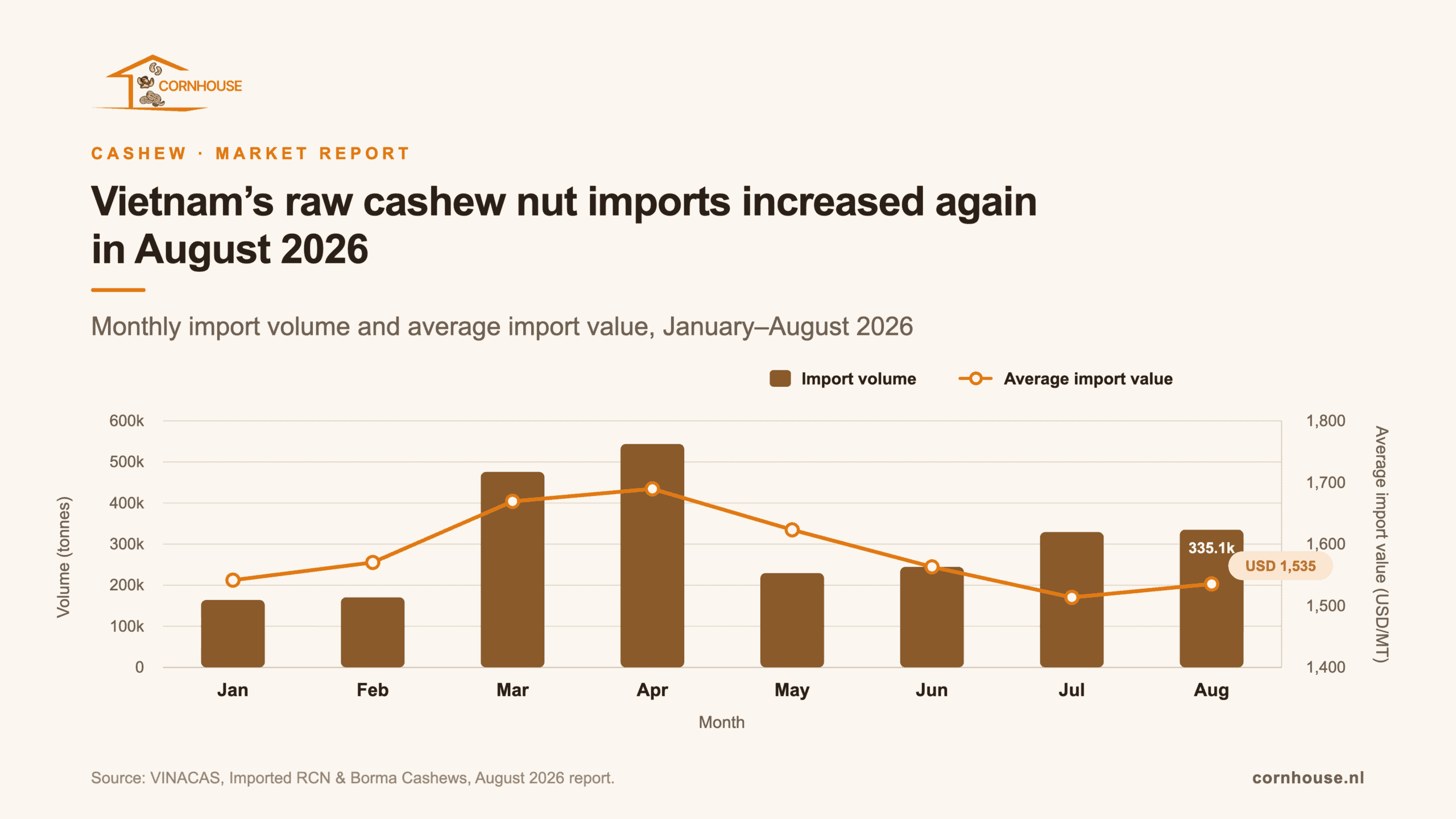
Vietnam imported 335,082 tonnes of raw cashew nuts in August, up 17.54% year on year and slightly above the 329,300 tonnes imported in July.
The value of August imports rose even faster, increasing 26.10% year on year to USD 514.5 million. The average import value reached USD 1,535 per tonne, 7.29% above August 2025.
Across January to August, Vietnam imported 2.49 million tonnes of RCN, an increase of 9.10% from the same period last year. Import expenditure increased 15.65% to just over USD 4.0 billion, while the average import value rose 2.91% to USD 1,588 per tonne.
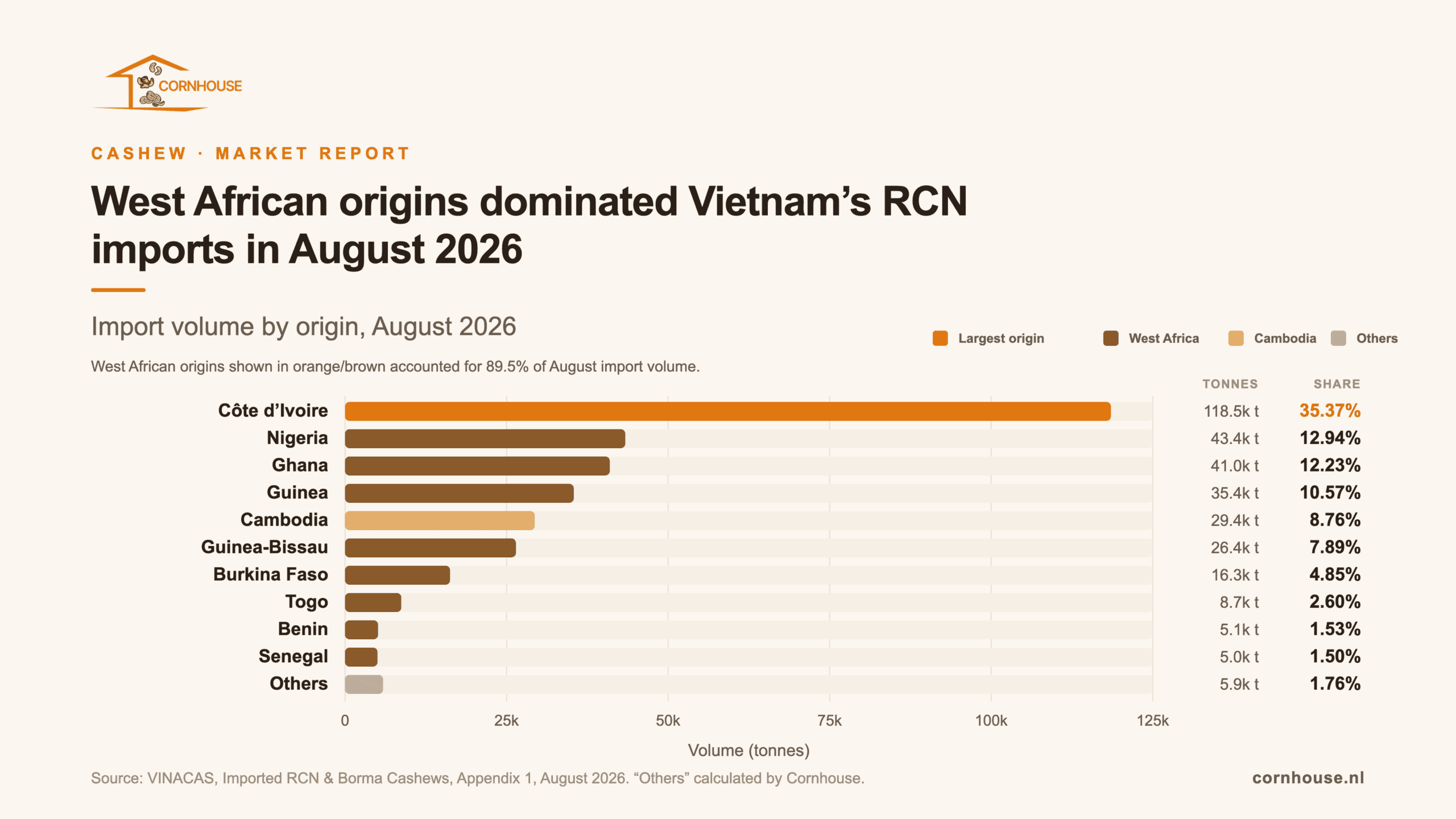
August also showed a clear change in the origin mix as the Cambodian season faded and West African supply became more prominent.
Côte d’Ivoire was Vietnam’s largest RCN supplier during the month, providing 118,534 tonnes, equivalent to 35.37% of August imports. Nigeria supplied 43,371 tonnes, Ghana 40,974 tonnes and Guinea 35,406 tonnes. Cambodia contributed 29,354 tonnes, or 8.76% of the monthly total.
Across the first eight months as a whole, Cambodia remained the largest source with 43.47% of RCN imports, followed by Côte d’Ivoire at 18.35%, while all other origins combined accounted for 38.19%.
Raw material costs shape the Vietnam cashew market
The latest VietPhi market overview describes a somewhat firmer RCN market as the West African season approaches its end. Availability of higher-quality, high-outturn material is becoming more limited, while Indian buying ahead of the festive season is adding support to better-quality RCN.
VietPhi indicates Côte d’Ivoire RCN around USD 1,475–1,620 per tonne CFR Asia/Vietnam, depending on outturn, while higher-outturn Guinea-Bissau material was indicated around USD 1,775–1,810 per tonne.
The report notes that Vietnamese processors remain selective because raw-material replacement costs have strengthened faster than kernel prices, leaving margins under pressure.
This is consistent with the VINACAS import data. Although the overall August RCN import value averaged USD 1,535 per tonne, prices varied materially by origin. The average import value from Côte d’Ivoire was USD 1,478 per tonne, while Cambodian RCN averaged USD 1,999 per tonne, 25.72% above August 2025.
WW320 remains relatively stable while larger grades are better supported
Despite firmer raw-material costs, VietPhi describes the kernel market as comparatively stable.
WW320 was indicated around USD 3.14/lb FOB Vietnam, with prompt AFI/BRC-standard offers generally around USD 3.10–3.25/lb. Larger certified processors were typically indicating around USD 3.20–3.25/lb for nearby European and US positions.
WW240 remained better supported at approximately USD 3.45–3.60/lb, while WW180 and WW210 continued to show tighter availability.
According to VietPhi, lower average RCN outturns have restricted the availability of larger premium kernels. This has kept the premium of WW240 and other large grades over WW320 relatively wide.
Buyers are returning, but purchasing remains selective
VietPhi reports that European buyers are gradually returning following the summer holiday period, while retailer tenders for Q4 2026 and 2027 coverage have started to emerge. Purchasing nevertheless remains selective.
US buying also remains cautious, with buyers focusing on nearby requirements, consistent quality and reliable suppliers rather than aggressively extending forward coverage.
Chinese demand continues to support larger whole grades, while Indian domestic demand remains firm ahead of the festive season.
For processors, the central issue is increasingly the relationship between current kernel prices and the cost of replacing raw material. VietPhi reports that some smaller processing units have reduced or suspended operations following continued margin pressure, while larger certified processors remain more reluctant to follow lower bids, particularly for forward positions.
East African supply becomes the next major variable
Attention is now beginning to shift towards the upcoming crops in Tanzania and Mozambique.
VietPhi describes early Tanzanian crop expectations as promising, but stresses that final production and quality remain uncertain. The arrival, quality and pricing of East African RCN will therefore be an important variable for Vietnam’s replacement costs during the fourth quarter.
For the kernel market, the immediate question is whether returning European and US demand develops into firm contracts while RCN replacement costs remain elevated.
For now, the data point to a market in which Vietnamese exports remain ahead of last year, China retains its position as the largest individual destination, and raw-material economics are becoming increasingly important even though WW320 prices themselves have not yet moved sharply higher.
The next few weeks should provide greater clarity on both Western forward demand and the availability of the new East African RCN crop.
Sources: VINACAS August 2026 cashew-kernel export and RCN import reports, published 14 September 2026; Viet Phi Cashews / Tan Long Group, Cashew Market Overview – September 2026.

 We use cookies to ensure you get the best experience on our website. For more information, please read our