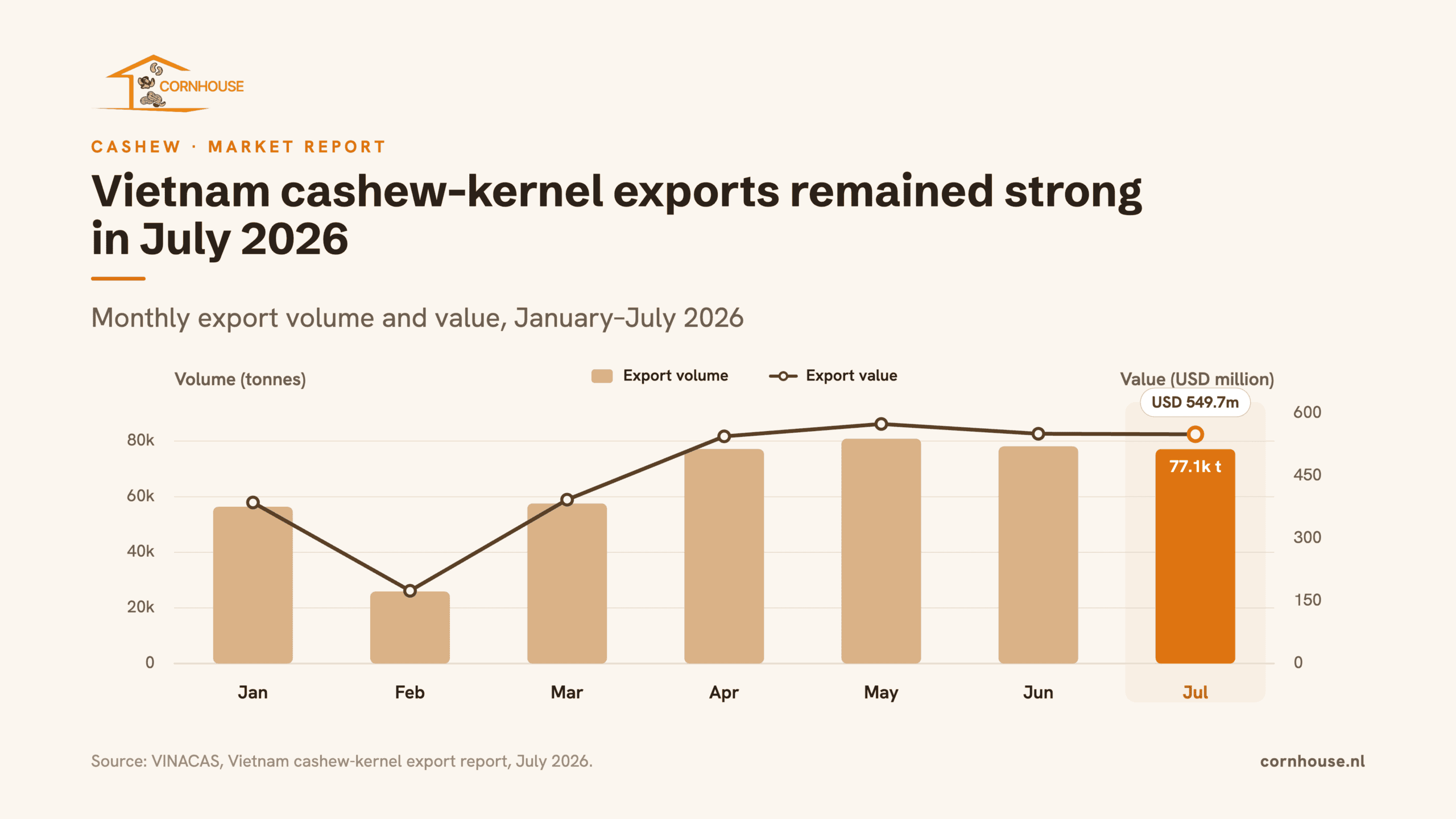
Vietnam cashew exports remained strong in July 2026, with kernel shipments rising 9.26% year on year to 77,093 tonnes, according to the latest VINACAS data. Export value increased faster, climbing 15.07% to USD 549.7 million, while the average export value reached USD 7,130 per tonne.
For the first seven months of the year, Vietnam exported 453,052 tonnes of cashew kernels, up 6.50% from the same period in 2025. Export value reached USD 3.17 billion, an increase of 9.56%. This extends the strong export performance recorded in our previous cashew market update.
China remained Vietnam’s largest individual export destination in July, while shipments to the United States also continued to grow strongly. Beneath these headline figures, however, the market is becoming increasingly differentiated by grade, raw-material quality and the timing of buyer demand.
Vietnam cashew exports remain led by China
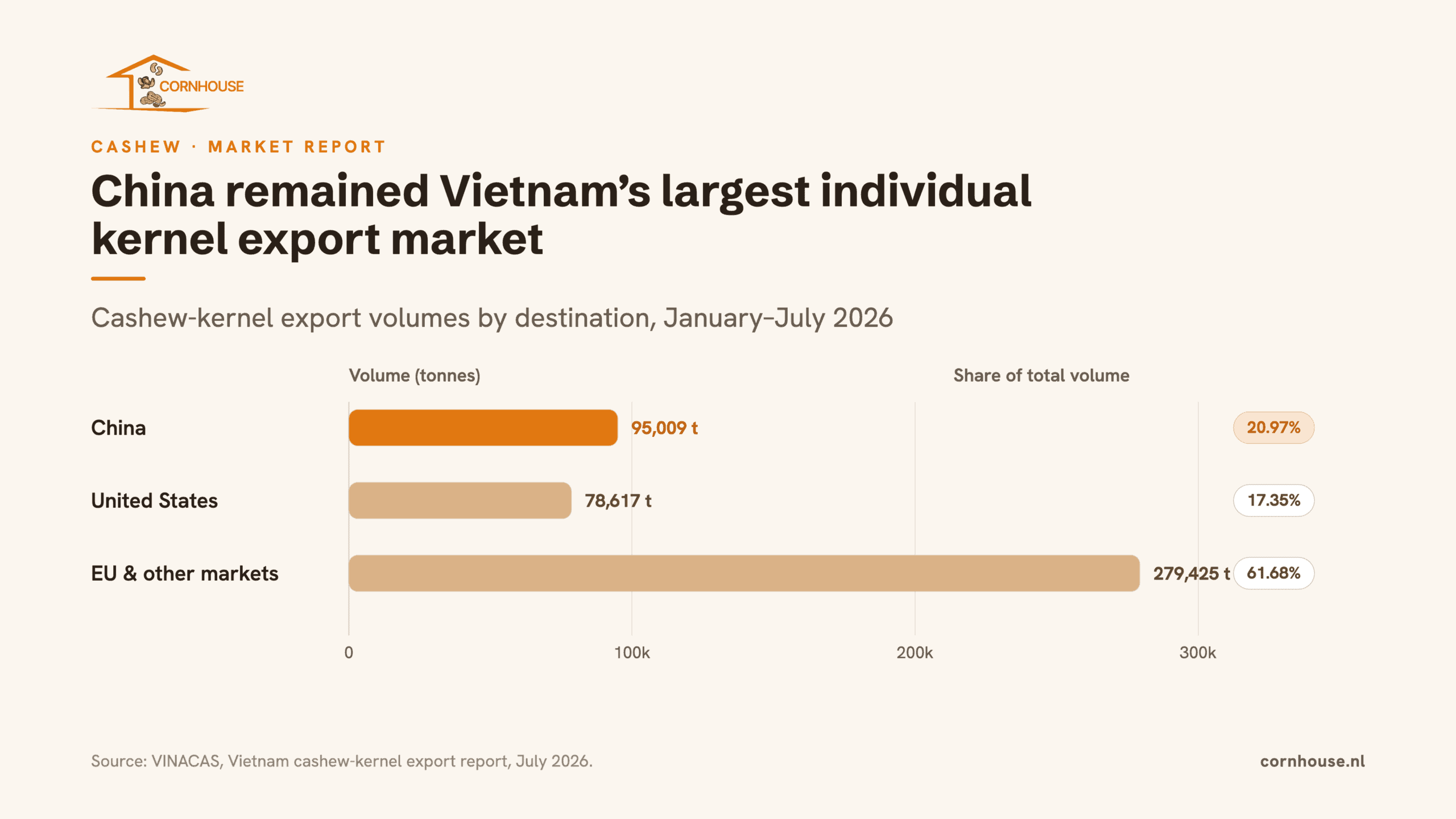
Vietnam shipped 16,971 tonnes of cashew kernels to China in July, 41.81% more than in July 2025. China accounted for 22.01% of Vietnam’s total kernel exports during the month.
Exports to the United States reached 13,658 tonnes, up 20.93% year on year and representing 17.72% of July exports.
Over January-July, China received 95,009 tonnes from Vietnam, an increase of 12.59%, compared with 78,617 tonnes shipped to the United States. US volumes nevertheless recorded the faster year-on-year growth, rising 29.00%.
The wider group of EU and other markets absorbed 279,425 tonnes during the first seven months, broadly unchanged from last year at -0.23%.
Average export values also remained firm. In July, kernels exported to China averaged USD 7,332 per tonne, 17.09% above July 2025. The US average reached USD 7,102 per tonne, up 5.38%, while other destinations averaged USD 7,065 per tonne, up 2.30%.
WW320 remains softer while larger grades stay better supported
The overall increase in Vietnam’s average kernel export value does not mean all grades are moving in the same direction.
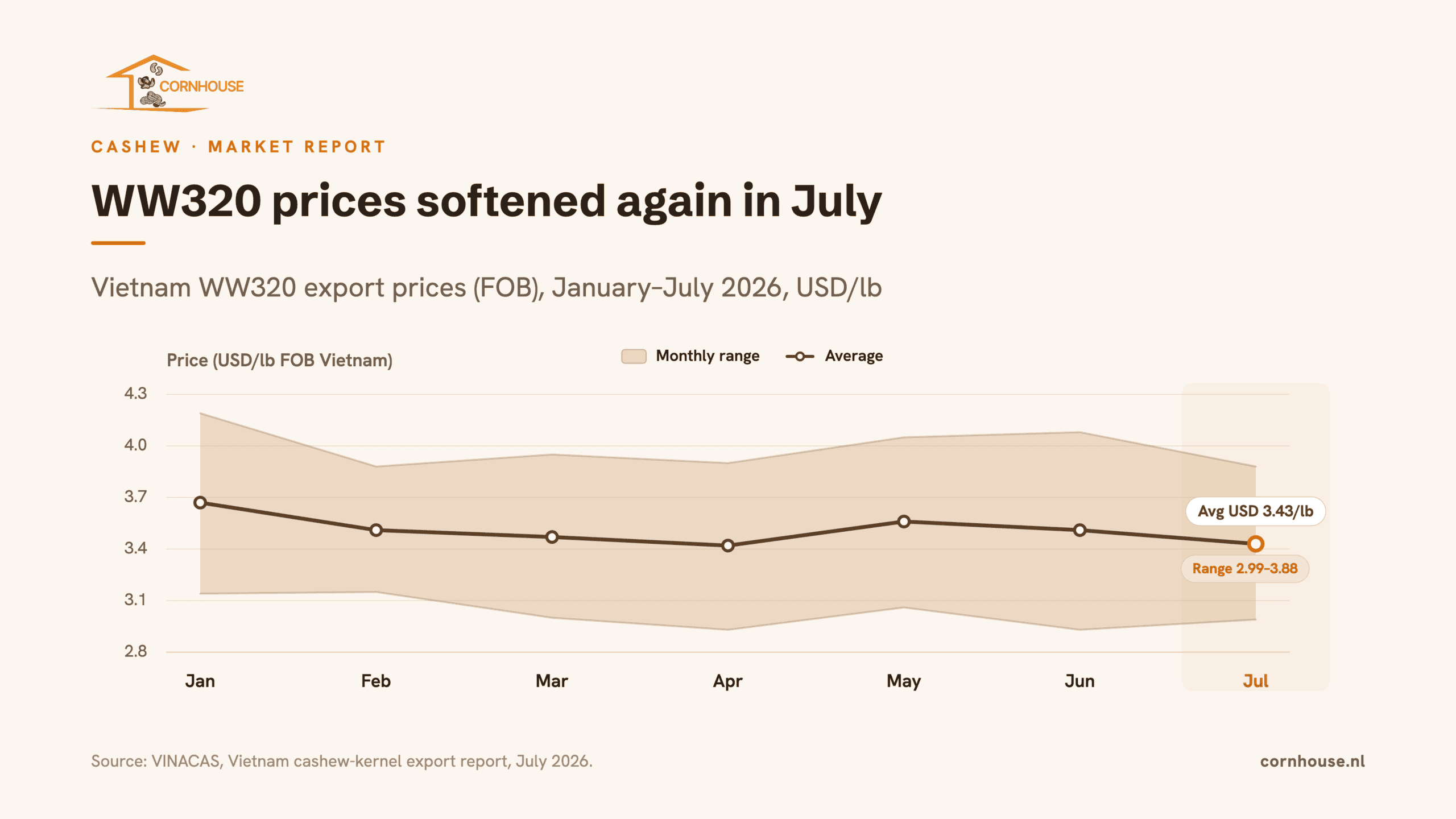
VINACAS reported an average July WW320 export price of USD 3.43/lb FOB Vietnam, compared with USD 3.51/lb in June and USD 3.56/lb in May. The July level was also 1.60% below the average recorded a year earlier.
Viet Phi Cashews describes a similarly differentiated kernel market. Its August market overview indicates that WW320 continues to face competitive pressure during the seasonally quieter Western buying period, while WW180, WW210 and WW240 are better supported by more limited availability.
The distinction is important. Softer WW320 offers do not necessarily indicate equivalent weakness across the entire kernel market.
According to Viet Phi, some Vietnamese processors remain under margin pressure and are offering WW320 more competitively to generate cash flow, while larger grades are being offered less aggressively because availability is tighter.
Vietnam has sufficient RCN volume, but quality is becoming more important
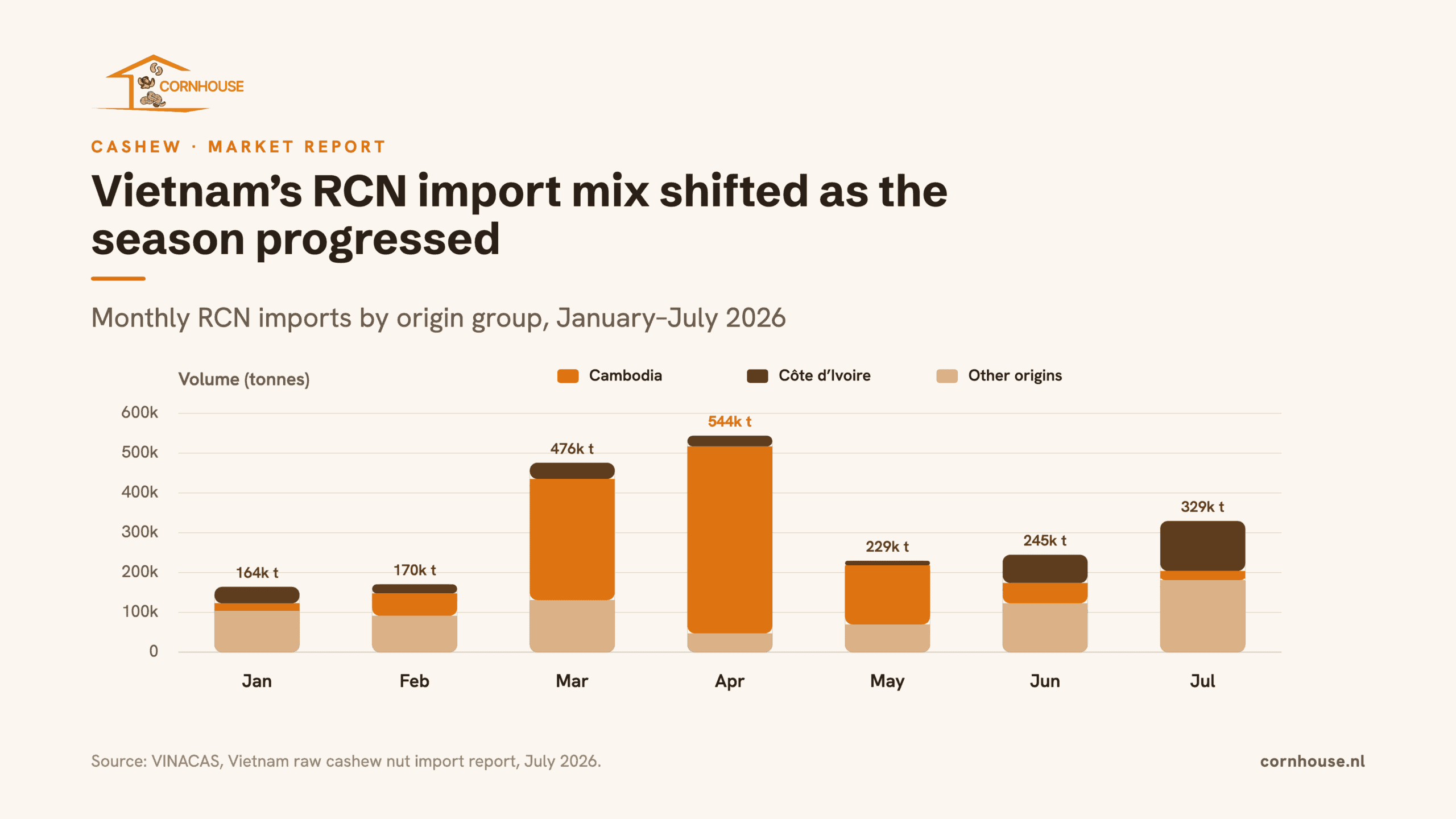
Vietnam imported 329,300 tonnes of raw cashew nuts (RCN) in July, broadly unchanged from July 2025. Import value increased 5.44% to USD 498.4 million.
The July volume was also substantially higher than the 244,556 tonnes imported in June.
Cumulative RCN imports reached 2.157 million tonnes during January-July, up 7.90% year on year, while import value increased 14.25% to USD 3.49 billion.
The composition of arrivals has shifted as the season has progressed. Côte d’Ivoire became Vietnam’s largest RCN origin in July with 125,296 tonnes, representing 38.05% of the month’s imports. Nigeria followed with 68,021 tonnes, Ghana with 44,224 tonnes and Guinea with 43,473 tonnes.
Cambodia supplied only 23,052 tonnes in July, or 7.00% of the monthly total. However, its much larger shipments earlier in the season mean it remains Vietnam’s leading RCN origin for 2026 so far, accounting for 48.86% of cumulative imports.
Viet Phi reports that Vietnamese processors currently hold relatively comfortable raw-material inventories, with additional cargoes arriving during August. The more important distinction is increasingly one of quality rather than total volume.
As the West African season approaches its later stages, high-quality and higher-outturn RCN is becoming more difficult to source, while lower-quality late-season material remains more readily available. This helps explain why sufficient overall RCN availability can coexist with tighter availability of larger kernel grades.
Quiet spot activity may understate underlying WW320 demand
Western buying has remained seasonally subdued during the summer period. Viet Phi expects European and US activity to gradually return from late August into September as buyers begin covering remaining Q4 requirements and early 2027 positions.
We are also seeing indications that underlying WW320 interest may be stronger than visible spot activity suggests. Sizable enquiries from European and US roasters have been circulating in the market, although this interest has not yet translated fully into concluded business.
Viet Phi agrees that the visible spot market remains quiet but notes that underlying buying interest could be stronger than currently apparent. If larger enquiries begin converting into contracts, market conditions could therefore change relatively quickly.
For now, the distinction between enquiries and executed business remains important. The buying interest is a market signal rather than evidence that a broader price move has already begun.
India supports demand, while Tanzania becomes an early crop watchpoint
India is another supportive demand market, although the mechanism differs from China, Europe and the United States.
Viet Phi reports stronger Indian festive-season buying, driven mainly by domestic demand rather than large purchases of Vietnamese kernels. VINACAS data are consistent with that distinction: Vietnam exported only 171 tonnes of kernels to India in July, equivalent to 0.22% of its total monthly exports.
Attention is also beginning to turn towards the next East African crops.
Early indications from Tanzania are positive, according to Viet Phi, with market expectations for another strong crop and the possibility that production could exceed last season. However, the company cautions that it remains too early to confirm the final crop size.
For Indonesia, reliable early crop estimates are not yet available.
What to watch next
Vietnam’s July figures continue to show healthy kernel exports and substantial RCN availability, but the underlying market is increasingly difficult to describe with a single price direction.
WW320 remains relatively competitive during the quieter Western buying period, while tighter high-outturn RCN and limited availability of larger kernels are supporting premium grades.
The next important test will come as European and US buyers return more actively to the market from late August into September. Whether the sizable WW320 enquiries currently being discussed convert into contracts will help determine whether today’s relatively quiet spot market persists.
At the same time, RCN quality and the first more reliable indications from Tanzania will become increasingly important as the industry begins looking beyond the West African season towards the next supply cycle.
Sources: VINACAS July 2026 import and export reports; Viet Phi Cashews August 2026 Market Overview.

 We use cookies to ensure you get the best experience on our website. For more information, please read our