Vietnam’s cashew market recorded a decline in kernel exports in September 2026, even as average export unit values remained above last year’s levels. According to the latest VINACAS reports, kernel shipments fell by 8.79% year on year, while raw cashew nut (RCN) import costs continued to increase.
The September figures reveal a contrast between weaker monthly kernel exports and higher import expenditure. China and the United States nevertheless remained growth markets over the first nine months of the year.
This follows the developments covered in our August Vietnam cashew market update, which reported stronger cumulative exports and rising RCN import unit values.
Vietnam cashew market: kernel exports decline in September
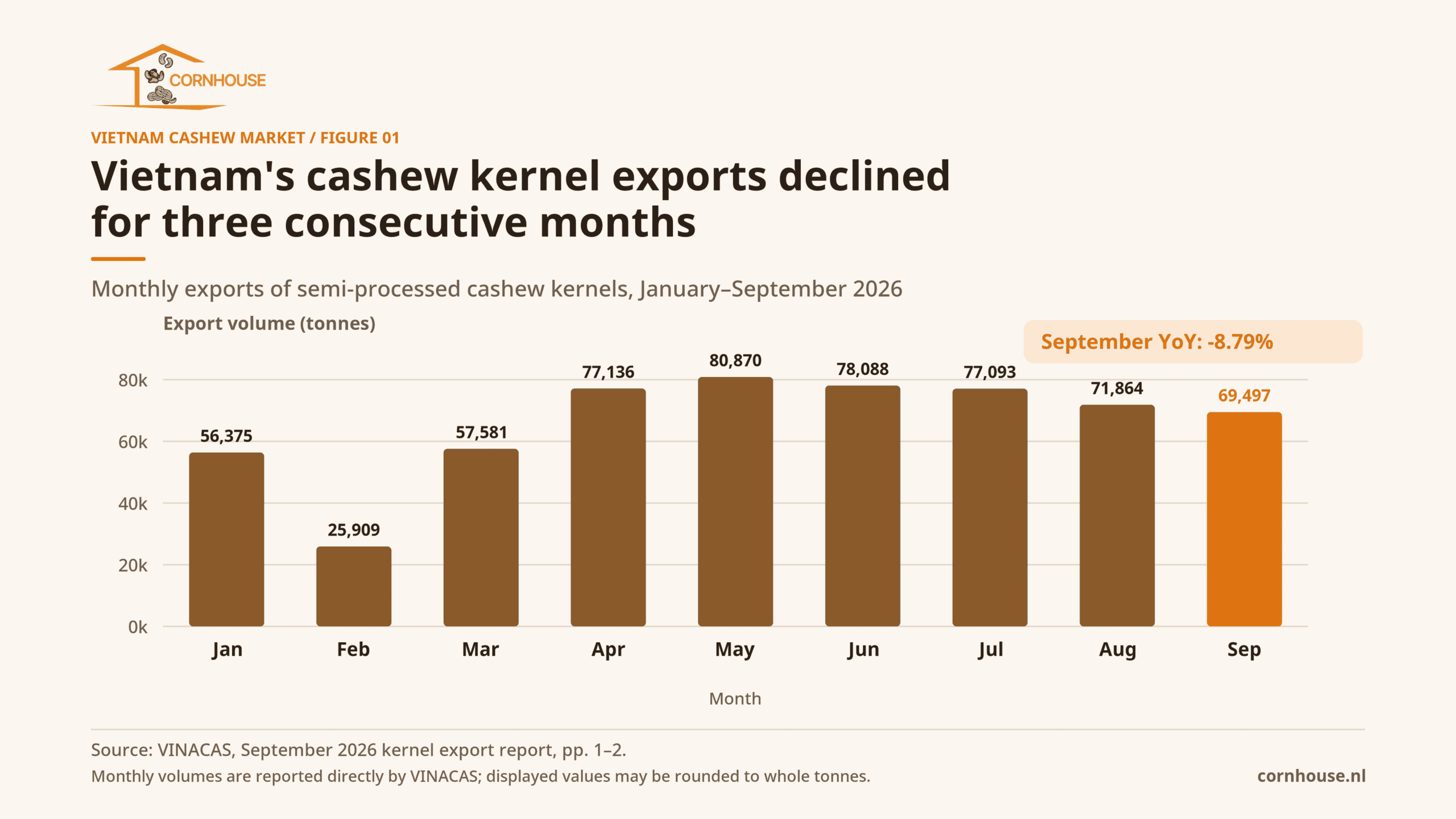
Vietnam exported 69,497 tonnes of semi-processed cashew kernels in September 2026, generating USD 500.8 million in export revenue, according to VINACAS.
Shipment volumes declined by 8.79% compared with September 2025, while export value fell by a smaller 2.74%. The average export unit value reached USD 7,206 per tonne, an increase of 6.63% year on year.
September also marked a third consecutive monthly decline in export volumes from June’s 78,088 tonnes. Shipments decreased to 77,093 tonnes in July, 71,864 tonnes in August and 69,497 tonnes in September.
Despite the slower monthly performance, cumulative export figures remained ahead of 2025.
Between January and September, Vietnam exported 594,413 tonnes of cashew kernels, an increase of 3.52% year on year. Export revenue reached USD 4.19 billion, up 7.35% over the same period.
By the end of September, Vietnam had achieved 74.30% of VINACAS’s annual export-volume target of 800,000 tonnes and 83.80% of its USD 5 billion export-value target.
China and the United States support year-to-date growth
China remained Vietnam’s largest individually identified export destination in September, receiving 15,016 tonnes of cashew kernels. This represented a decline of 10.20% compared with September 2025.
The United States received 10,568 tonnes, an increase of 7.00% year on year.
The difference becomes more pronounced when considering the first nine months of 2026.
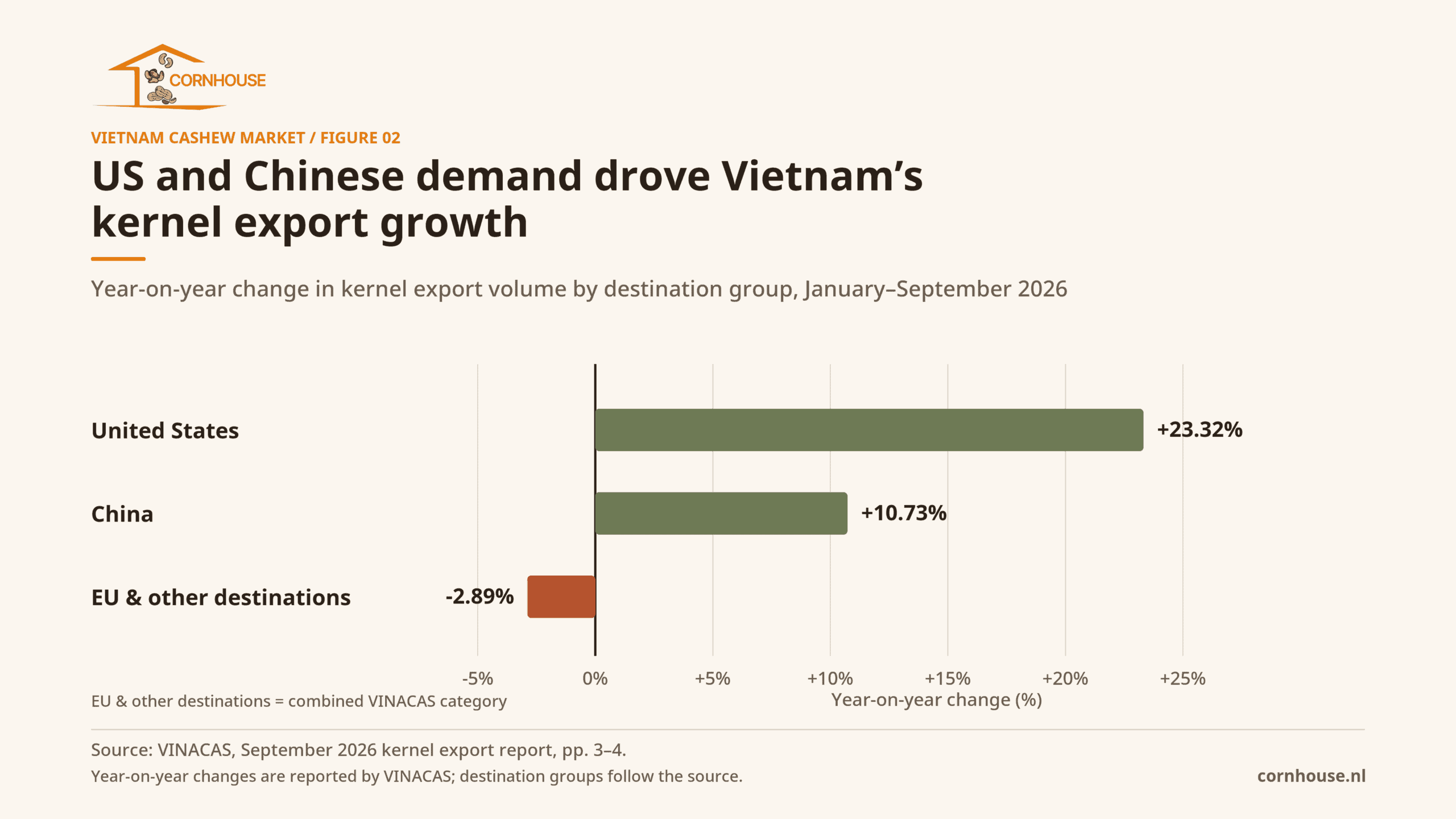
Vietnam exported 124,859 tonnes to China between January and September, an increase of 10.73% year on year. The corresponding export value rose by 28.15%, reaching USD 907.5 million.
Exports to the United States totalled 100,853 tonnes, up 23.32%, while export value increased by 27.87% to USD 701.6 million.
In contrast, shipments to the combined category of European markets and other destinations declined by 2.89% to 368,701 tonnes during the same period.
The figures show that Vietnam’s cumulative export growth was unevenly distributed across destination markets. China and the United States recorded increases, while the broader group of remaining destinations contracted.
For longer-term context on Europe’s sourcing structure, see our analysis of European cashew imports between 2015 and 2025.
Raw cashew imports remain above 2025 levels
Vietnam imported 282,725 tonnes of raw cashew nuts in September, an increase of just 0.63% compared with the same month last year.
However, the value of those imports increased by 8.82% to USD 434.6 million. The average import unit value reached USD 1,537 per tonne, up 8.14% year on year.
This continued the pattern of raw-material import expenditure rising faster than import volumes.
For January–September 2026, Vietnam’s RCN imports totalled 2.77 million tonnes, an increase of 8.18% compared with the corresponding period in 2025.
The cumulative import value reached USD 4.44 billion, up 14.95%.
VINACAS reported that Vietnam had already reached 86.71% of its annual RCN import-volume target of 3.2 million tonnes, while the value of imports had exceeded its annual target of USD 4.16 billion.
The figures indicate that Vietnam continued importing substantial volumes of raw material even as monthly kernel export shipments slowed towards the end of the third quarter.
Cambodia and Côte d’Ivoire dominate raw-material sourcing
Cambodia remained Vietnam’s largest RCN supplier over the first nine months of 2026, accounting for 1.10 million tonnes, an increase of 11.82% year on year.
Côte d’Ivoire supplied another 561,091 tonnes, up 0.92%.
Together, the two origins represented approximately 60% of Vietnam’s recorded RCN import volume during January–September.
However, the September breakdown shows a different seasonal pattern.
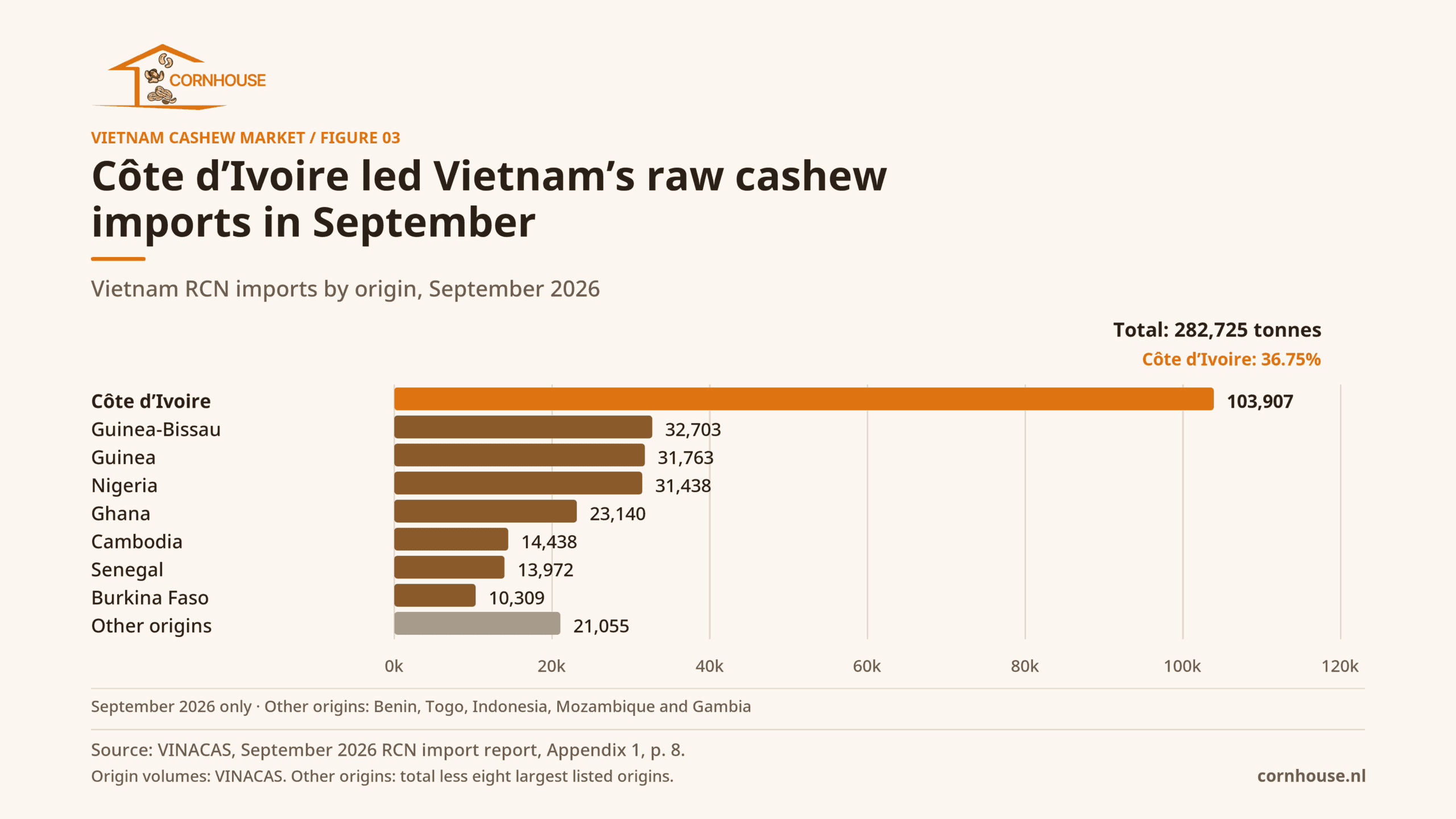
Côte d’Ivoire was the largest supplier during the month, shipping 103,907 tonnes to Vietnam, representing 36.75% of September’s RCN imports. This was 27.71% below September 2025.
Cambodian shipments were considerably smaller at 14,438 tonnes, down 13.53% year on year.
Guinea-Bissau, Guinea, Nigeria and Ghana were also among the major origins in September, collectively supplying more than 119,000 tonnes.
The figures highlight the changing composition of Vietnam’s raw-material imports between the first nine months as a whole and September individually.
WW320 prices recover slightly from August
VINACAS also reported a modest month-on-month recovery in its indicative WW320 export-price measure.
The reported midpoint of monthly high and low FOB Vietnam prices rose from USD 3.23/lb in August to USD 3.34/lb in September.
However, the September figure remained 7.45% below the corresponding measure for September 2025.
VINACAS recorded a September price range of USD 2.60–4.08/lb FOB Vietnam, a spread of USD 1.48/lb.
This price measure should be distinguished from the average export unit value calculated from customs trade data. The WW320 figure is based on the midpoint of reported high and low prices rather than a volume-weighted average of transactions.
The combination of higher year-on-year customs export unit values and a lower WW320 midpoint demonstrates the importance of distinguishing between different price measures when assessing Vietnam’s kernel market.
What the September figures show
The September VINACAS reports highlight three developments: weaker monthly kernel export shipments, higher year-on-year raw-material import unit values and continued growth in cumulative exports to China and the United States.
Although Vietnam’s nine-month export performance remained positive, the latest monthly data show a slowdown in shipments during the third quarter.
The next VINACAS release will help establish whether this decline continues into the final quarter of 2026, and whether the difference between raw-material import costs and kernel export performance persists.
Source: VINACAS, September 2026 reports on cashew kernel exports and raw cashew nut imports, dated 15 October 2026.
For more information about our sourcing activities, explore Cornhouse’s cashew product and origin overview.

 We use cookies to ensure you get the best experience on our website. For more information, please read our