Net external imports of cashew kernels into the EU27 and UK increased by almost 95% between 2015 and 2025. Our analysis of official trade statistics shows which European markets recorded the largest increases, why trading hubs tell a different story, and how the continent’s supply relationships have changed.
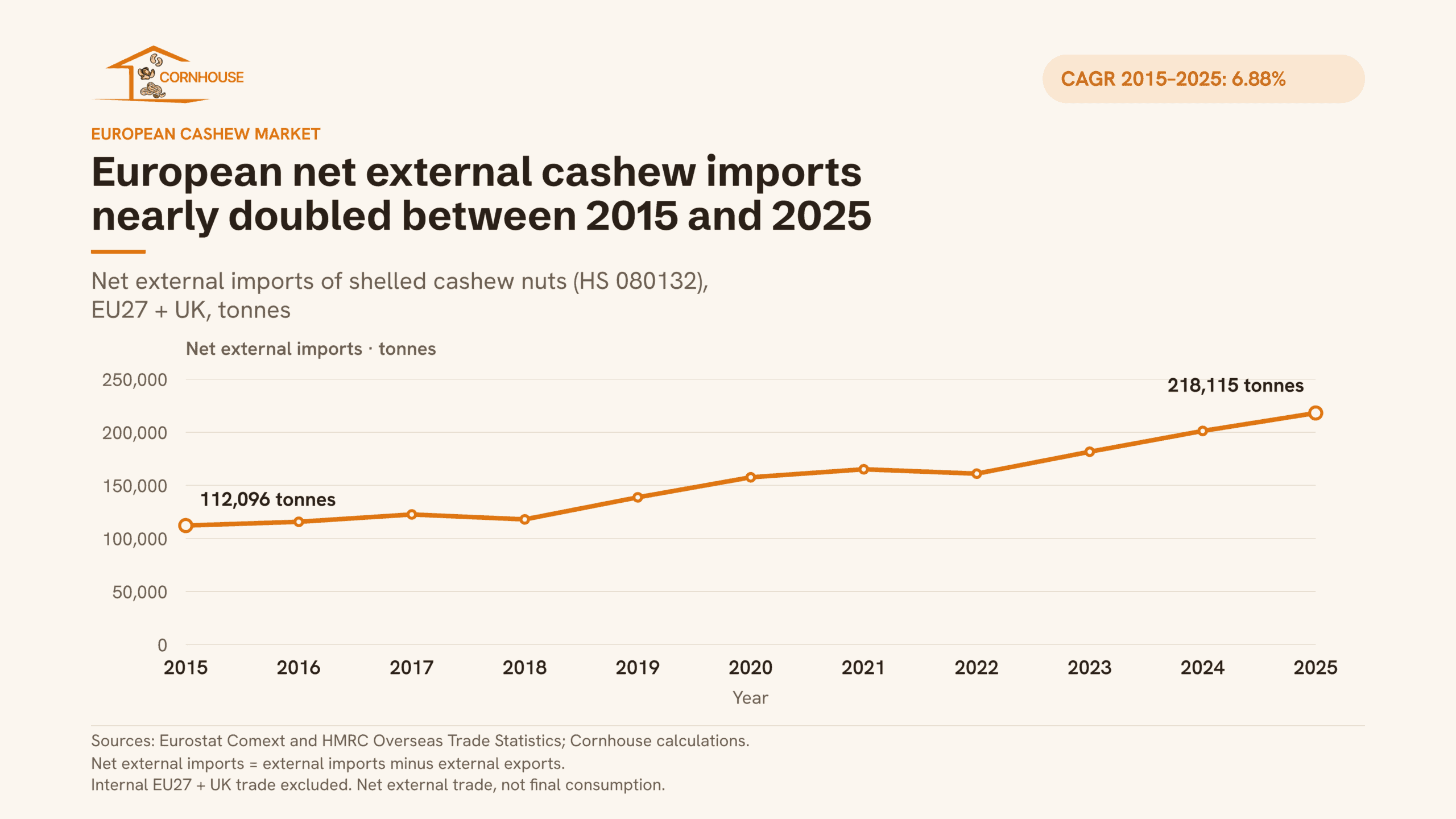
European cashew imports have nearly doubled over the past decade. Our analysis of Eurostat Comext and HMRC trade statistics shows that net external imports of shelled cashew nuts into the EU27 and UK rose from 112,096 tonnes in 2015 to 218,115 tonnes in 2025.
That represents an increase of 94.6%, equivalent to a compound annual growth rate (CAGR) of 6.88% over ten years.
The figures are particularly significant because trade between the EU27 and UK has been excluded. Europe’s expansion is therefore not simply the result of cashews being counted repeatedly as they move between European countries.
Instead, the data show substantially higher net external supply, with Germany recording the largest increase in national net imports, followed by Italy, Spain and France. At the same time, Europe’s sourcing relationships have shifted considerably, particularly towards Vietnam and Côte d’Ivoire.
European cashew imports: a decade of growth
Europe’s net external imports of cashew kernels increased by approximately 106,000 tonnes over the decade.
The development was not entirely consistent. Volumes declined in 2018 and 2022, but both setbacks were followed by renewed growth.
The most recent years show particularly strong increases. Net external imports rose from 181,624 tonnes in 2023 to 201,230 tonnes in 2024, reaching 218,115 tonnes in 2025.
The latest annual increase was 8.4%, adding almost 16,900 tonnes of net external supply.
These figures cover shelled cashew nuts under HS 080132, rather than raw cashew nuts (RCN) or further prepared products.
The geographical definition also remains constant throughout the entire period: the same 27 EU member states plus the United Kingdom, including the years before and after Brexit.
This distinction matters. Simply adding national imports together would count some cashews more than once as they move between European trading and processing centres.
On that basis, our analysis identifies a substantial increase in kernels entering the European market from outside the region, net of outward exports.
Germany leads the increase, while Italy, Spain and France expand
The country-level data reveal where much of the additional volume is recorded after national exports are deducted.
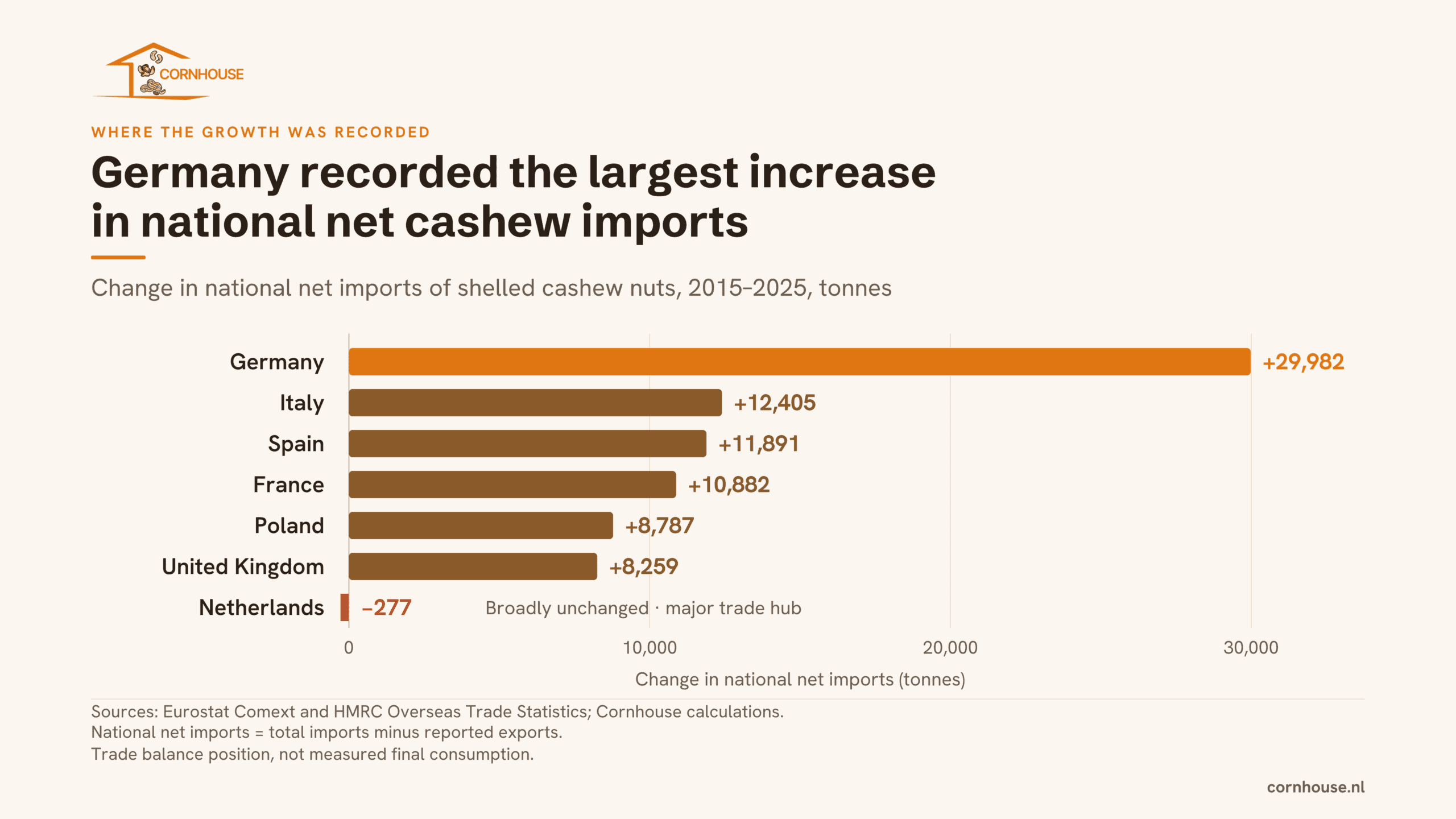
Germany experienced the largest absolute increase in national net imports between 2015 and 2025, rising by approximately 29,982 tonnes.
Italy followed with an increase of 12,405 tonnes, while Spain added 11,891 tonnes and France 10,882 tonnes.
Poland also recorded substantial growth, adding 8,787 tonnes, followed by the United Kingdom with 8,259 tonnes.
Together, these six markets represent approximately 78% of the increase in Europe’s net external import volume when measured through their reported national net-import changes. The remaining difference reflects other markets and statistical discrepancies between reported intra-European trade flows.
The figures highlight two important developments.
Germany remains a major destination for cashew kernels, accounting for the largest absolute expansion. Meanwhile, the increases in Italy, Spain, France and Poland indicate that market absorption is expanding across a broader geographical area.
For exporters and suppliers, this makes individual destination markets increasingly relevant. Europe’s overall growth rate does not tell the full story of where additional volumes are being absorbed.
National net imports, however, should not be treated as a direct measure of consumption. Inventory changes, processing activity and statistical differences can affect the relationship between trade balances and final usage.
Why the Netherlands tells a different story
The Netherlands provides a useful illustration of why gross import growth can be misleading.
Dutch cashew kernel imports increased from approximately 50,603 tonnes in 2015 to 61,423 tonnes in 2025.
Yet exports also increased considerably, reaching approximately 46,910 tonnes in 2025.
As a result, the Netherlands’ calculated national net imports remained almost unchanged over the decade, declining slightly from 14,791 tonnes to 14,513 tonnes.
In 2025, Dutch exports were equivalent to approximately 76% of gross imports.
This does not diminish the country’s importance to the European cashew industry. Rather, it illustrates its role as a trading, processing and redistribution centre supplying other European markets.
A large volume entering the Netherlands may subsequently move to another European country, where it appears in national import statistics again.
For the combined EU27 and UK market, such internal movements have been removed from the external trade calculation.
The distinction is essential: growth in activity at an import hub does not necessarily mean an equivalent increase in the volume retained within that country’s market.
Vietnam remains dominant as Côte d’Ivoire strengthens its position
Europe’s growing imports have been accompanied by a notable shift in its supplier structure.
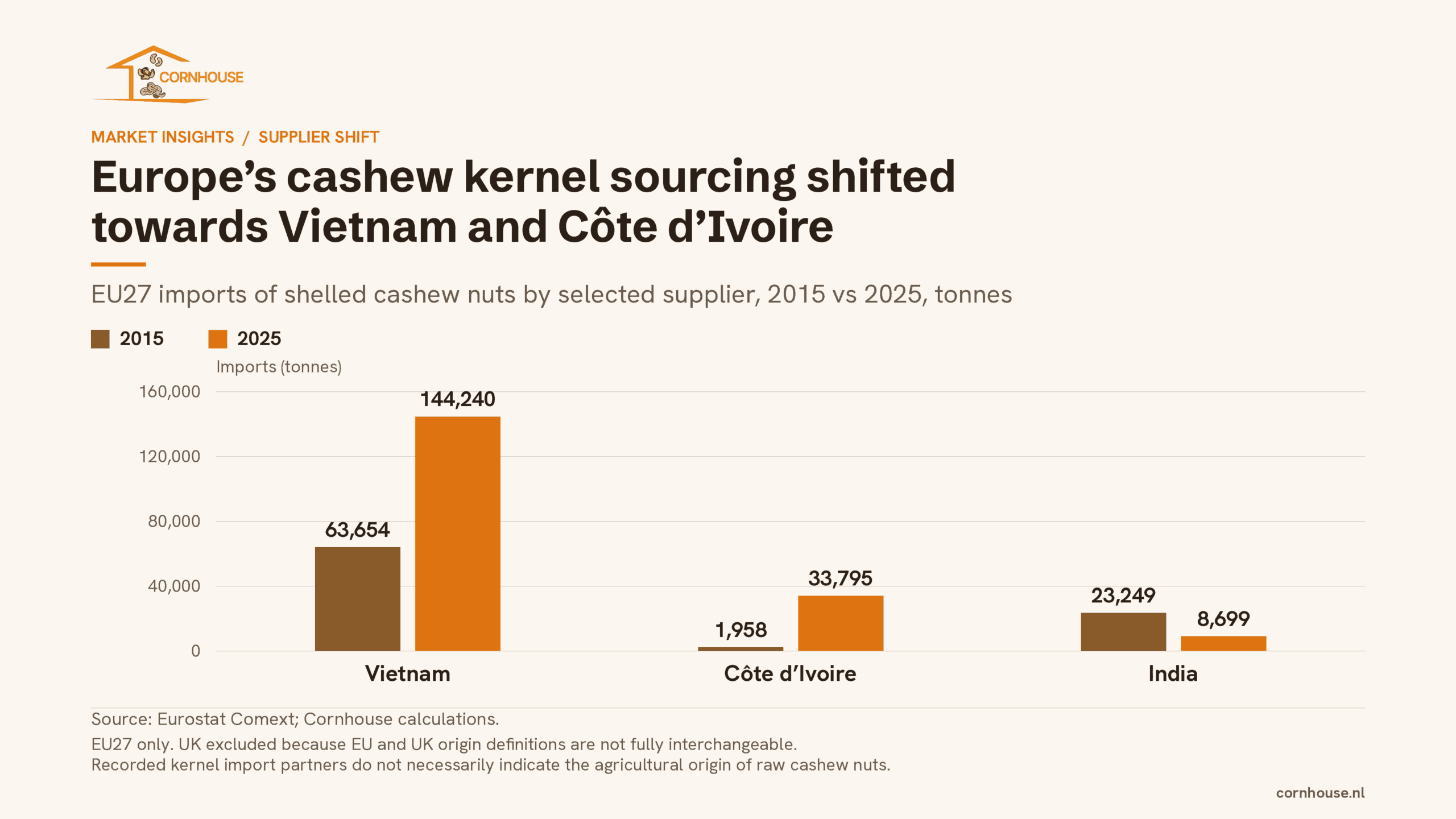
Vietnam remains the largest recorded supplier of cashew kernels to the EU27. Imports from Vietnam increased from approximately 63,654 tonnes in 2015 to 144,240 tonnes in 2025, an increase of 80,586 tonnes.
Côte d’Ivoire recorded an even more striking relative expansion. EU27 imports from the country rose from 1,958 tonnes to 33,795 tonnes, adding 31,837 tonnes over the decade.
India moved in the opposite direction, with imports declining from 23,249 tonnes to 8,699 tonnes.
These changes indicate a substantial reorganisation of Europe’s direct kernel sourcing.
Vietnam retains a dominant role through its established processing and export industry. Meanwhile, the increase in shipments from Côte d’Ivoire demonstrates the growing relevance of processed cashew kernel supply from West Africa.
This development is commercially relevant for European importers assessing supplier diversification, processing locations and direct sourcing relationships.
However, the figures describe recorded kernel import partners, not necessarily the agricultural origin of every raw cashew nut. RCN harvested in one country may be processed and exported as kernels from another.
The supplier comparison also covers the EU27 rather than the combined EU27 and UK market, because the underlying European and British trade statistics do not use fully interchangeable origin definitions.
Does this mean Europeans are consuming twice as many cashews?
Not necessarily.
Net external imports provide a useful measure of the additional kernel volume entering the European market, but they cannot establish final consumption without adjustments for inventories, domestic processing and other changes in product availability.
Additional research nevertheless supports the broader picture of expanding European demand.
The International Nut and Dried Fruit Council’s (INC) Statistical Yearbook 2024 reports higher estimated cashew consumption in several major European markets between 2019 and 2023, including Germany, the United Kingdom, France, Italy, Spain and Poland.
These estimates support the direction of the trade findings, although they cover a shorter period and are not a separate measurement of retail purchases.
Research published by the Centre for the Promotion of Imports from developing countries (CBI) also identifies snacking and food manufacturing as the principal European outlets for cashew kernels.
According to CBI, approximately 90% of imported cashew kernels are sold through the snack segment, while the remainder is primarily used as ingredients in food products.
Applications include nut mixes, spreads, snack bars, breakfast products, confectionery and sauces.
These uses help explain the range of potential outlets for cashews. However, the available data do not establish how much of the decade’s additional import volume resulted from each application or consumer trend.
The distinction remains important: Europe’s external kernel supply has almost doubled, but the precise growth in final consumption cannot be determined from the available trade and inventory data.
What the growth means for the cashew trade
The growth in European cashew imports points to three developments relevant to the international cashew industry.
First, Europe has become a significantly larger destination for imported kernels. Even after removing intra-European trade, the increase between 2015 and 2025 remains substantial.
Second, national markets are developing differently. Germany accounts for the largest increase in reported national net imports, while Italy, Spain, France and Poland represent important sources of additional market absorption.
Third, Europe’s supplier structure is changing. Vietnam remains dominant, but the rapid increase in kernel imports from Côte d’Ivoire shows how African processing is becoming more prominent in European sourcing.
For suppliers and buyers, these developments make it increasingly important to distinguish between import hubs and destination markets, and between the agricultural origin of RCN and the processing location of exported kernels.
The next question is whether the higher trade volumes continue to translate into growing end-user demand, particularly as prices, inventory positions and sourcing patterns change.
A larger market, with a changing structure
Europe’s cashew import growth over the past decade is not simply a statistical effect of trade moving between European countries.
Official trade data show that the EU27 and UK nearly doubled their net external imports of cashew kernels between 2015 and 2025.
The increase has been accompanied by expanding national net-import positions in several major markets and significant changes in the origins supplying European buyers.
Although the available evidence does not establish an equivalent increase in final consumption, it shows that Europe’s role as a destination for internationally traded cashew kernels has strengthened substantially.
For market participants, the important development is therefore not only how much Europe has grown, but which markets are taking additional volumes and how the supply relationships serving them are evolving.
Sources and methodology
Our calculations use official Eurostat Comext and HMRC Overseas Trade Statistics for shelled cashew nuts (HS 080132 / CN 08013200), covering the calendar years 2015–2025.
We apply a constant geographical boundary comprising the EU27 and United Kingdom, with internal trade excluded from the regional external import calculation. Country-level net imports are calculated separately as total imports minus reported exports.
Additional market context is drawn from the International Nut and Dried Fruit Council’s Statistical Yearbook 2024 and CBI’s European cashew market research.
Net external import growth should not be interpreted as measured consumption growth. Inventory changes and some processing adjustments are unavailable, while nine country-year export totals were not published in the underlying data extraction. The complete methodology and statistical reconciliations are documented in the accompanying research.

 We use cookies to ensure you get the best experience on our website. For more information, please read our